

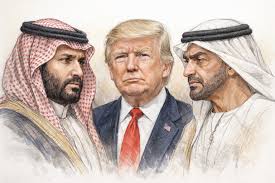
Reports circulating across social media have sparked intense debate over an alleged dramatic shift in foreign policy by Saudi Arabia, with claims suggesting the kingdom has distanced itself from the United States and its former ally, Donald Trump.
The viral claim, which describes the development as a “U-turn of the century,” alleges that Saudi Arabia declared it could “no longer stand with Trump” and urged the former U.S. president to “save himself first.” While the statement has generated widespread reactions online, there is currently no verified official communication from Saudi authorities confirming such a direct remark.
For over eight decades, Saudi Arabia and the United States have maintained one of the most strategic alliances in global geopolitics, rooted in energy cooperation, security arrangements, and mutual economic interests. The relationship dates back to the historic 1945 meeting between King Abdulaziz Ibn Saud and U.S. President Franklin D. Roosevelt, which laid the foundation for a partnership that has endured multiple global crises.
In recent years, however, analysts have observed subtle shifts in Saudi foreign policy. Under the leadership of Crown Prince Mohammed bin Salman, the kingdom has pursued a more independent and diversified global strategy, strengthening ties with countries such as China and Russia while recalibrating its relationship with Washington.
Experts caution that such strategic repositioning should not be confused with a complete break from the United States. “Saudi Arabia is expanding its diplomatic options, not abandoning its alliances,” a Middle East analyst noted. “What we are seeing is a pragmatic response to a changing global order.”
The mention of Donald Trump in the viral claim has also drawn scrutiny. During his presidency, Trump maintained close ties with Saudi leadership, particularly in areas of arms sales, regional security, and economic cooperation. However, since leaving office, Trump no longer represents official U.S. policy, making any direct diplomatic stance against him less relevant in formal international relations.
Political observers warn that misinformation and exaggerated narratives often emerge in times of geopolitical tension, especially on digital platforms where unverified claims can quickly gain traction. They emphasize the importance of relying on credible sources and official statements when assessing developments of such magnitude.
While it is true that Saudi Arabia has, at times, taken positions that diverge from U.S. preferences—particularly on oil production policies and regional diplomacy—there is no concrete evidence to support claims of a historic rupture or outright rejection of the longstanding alliance.
Nonetheless, the conversation highlights growing global interest in shifting power dynamics and the possibility of a more multipolar world order, where traditional alliances are increasingly tested by emerging economic and political realities.
As discussions continue, analysts agree on one point: any genuine “U-turn” in Saudi-U.S. relations would carry profound implications not just for the Middle East, but for global energy markets, security frameworks, and international diplomacy at large.


