

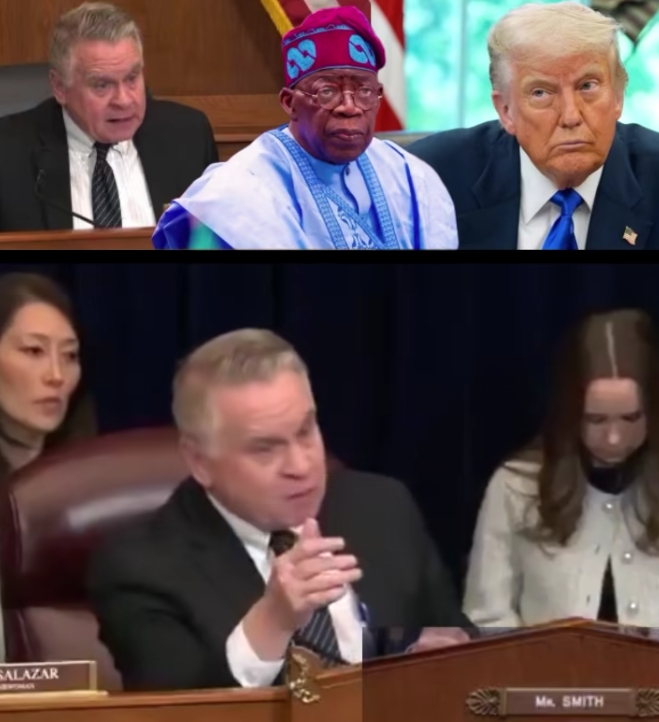
Breaking News:
Washington, D.C. — Senior U.S. Congressman has expressed deep concern over reports that the Nigerian government engaged a prominent Washington lobbying firm in a multi-million-dollar contract aimed at influencing U.S. policymakers.
According to Rep. Smith, Nigeria retained the K Street firm under a contract reportedly valued at $9 million — approximately $750,000 per month. He further alleged that a Nigerian billionaire separately entered into a $120,000-per-month agreement with to influence members of Congress and the executive branch.
“I’m deeply concerned that Nigeria has hired the K Street lobbying firm, DCI, to the tune of $9 million, $750,000 a month,” Rep. Smith stated. “And a Nigerian billionaire has entered into a $120,000 a month contract with the Valcour to influence Congress and the executive branch.”
The remarks add an international dimension to scrutiny surrounding the administration of President . Critics argue that such expenditures raise questions about governance priorities, especially amid domestic economic pressures, rising inflation, and social challenges facing Nigerians at home.
Supporters of the administration, however, may contend that sovereign governments routinely engage lobbying and public affairs firms in Washington to strengthen diplomatic relations, manage reputational issues, and advocate policy positions before U.S. lawmakers and federal agencies. Foreign governments operating in the United States commonly register such contracts under the Foreign Agents Registration Act (FARA), which mandates public disclosure.
Nonetheless, Rep. Smith’s intervention signals growing congressional interest in Nigeria’s political and governance trajectory. The New Jersey lawmaker, long known for his advocacy on human rights and religious freedom issues globally, has previously spoken on matters relating to Nigeria’s security and civil rights environment.
The reported financial scale of the contracts — $9 million annually for DCI Group and $120,000 monthly for The Valcour Group — has fueled debate among policy analysts and Nigerian civil society voices. Critics question whether such funds could be better deployed toward domestic development priorities, including healthcare, infrastructure, and economic stabilization.
At the time of reporting, there has been no official public rebuttal from the Nigerian presidency regarding Rep. Smith’s latest remarks. However, the issue is expected to intensify diplomatic and political conversations both in Washington and Abuja, particularly as Nigeria navigates complex international partnerships and internal reform demands.
The development underscores how domestic political decisions can increasingly reverberate on the global stage — especially when financial commitments intersect with foreign policy, lobbying transparency, and congressional oversight.


