

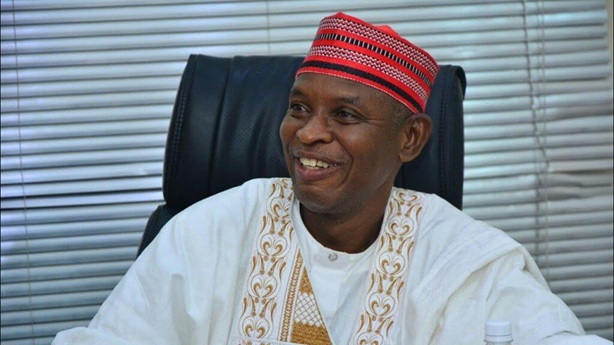
Kano State Governor, Abba Kabir Yusuf, has urged northern politicians aspiring to become president to defer their ambitions until 2031, arguing that the presidency should remain in the South through 2031 under an informal rotational arrangement.
Yusuf made the call on Sunday at the Kano Government House while unveiling 50 vehicles donated by Niger Delta businessman, Chief Government Ekpemupolo, popularly known as Tompolo, to support political mobilisation by the All Progressives Congress ahead of the 2027 general elections.
The governor said Nigeria should continue with a principle of rotational presidency between the northern and southern parts of the country, with each region allowed to produce a president for two consecutive terms.
According to Yusuf, allowing an administration to complete two terms would provide sufficient time to implement major policies, programmes and development projects.
He therefore called on Nigerians, particularly political stakeholders in the North, to support President Bola Tinubu’s bid for a second term in the 2027 presidential election.
“I urge support for President Bola Tinubu to complete his second term because this would allow the South to complete its two-term cycle before power returns to the North,” Yusuf said.
He added that political power should return to the North in 2031 after what he described as the South’s completion of its two-term cycle.
The governor’s position effectively calls on northern presidential aspirants and political groups seeking the presidency in 2027 to postpone their ambitions until the subsequent election cycle.
Yusuf said the principle of rotational presidency was intended to promote fairness, equity, national cohesion, mutual trust and a sense of belonging among Nigerians from different regions.
He argued that allowing the arrangement to continue would give different parts of the country an opportunity to participate in national leadership.
The governor also appealed to political parties and their supporters to conduct peaceful and issue-based campaigns ahead of the 2027 elections.
He urged politicians to concentrate on policies, programmes and development plans rather than personal attacks or inflammatory rhetoric that could undermine peace and national unity.
“Let us focus on issues, policies and programmes and avoid actions that can undermine peace and unity,” he said.
Yusuf’s comments come amid increased political activity ahead of the 2027 presidential election, with politicians and political movements across the country already mobilising supporters and building alliances.
His position also comes against the backdrop of political realignments in Kano. Yusuf was elected governor in 2023 on the platform of the New Nigeria Peoples Party but later defected to the APC. His former political ally and ex-Kano governor, Rabiu Kwankwaso, is now the vice-presidential candidate of the Nigeria Democratic Congress for the 2027 election. Kwankwaso has said he remains open to reconciliation with Yusuf.
Other political actors have taken different positions on the 2027 contest, meaning the question of regional rotation remains part of a broader political debate rather than a constitutional requirement.
Nigeria’s Constitution does not prescribe a North-South rotation of the presidency. The constitutional framework provides for presidential elections and sets out eligibility, electoral and tenure requirements, while regional rotation is generally discussed as a political convention or informal understanding.
Yusuf nevertheless maintained that the arrangement would strengthen national unity and called on political stakeholders to prioritise peaceful democratic engagement.
He also urged political actors to place the interests of Kano State and Nigeria above partisan differences as preparations for the 2027 elections intensify.


