
A Nigerian artist, Biqlion, has turned the spotlight on one of the country’s most disturbing but often overlooked crises — the deplorable condition of public primary schools — following a tour of dilapidated classrooms across Nigeria.
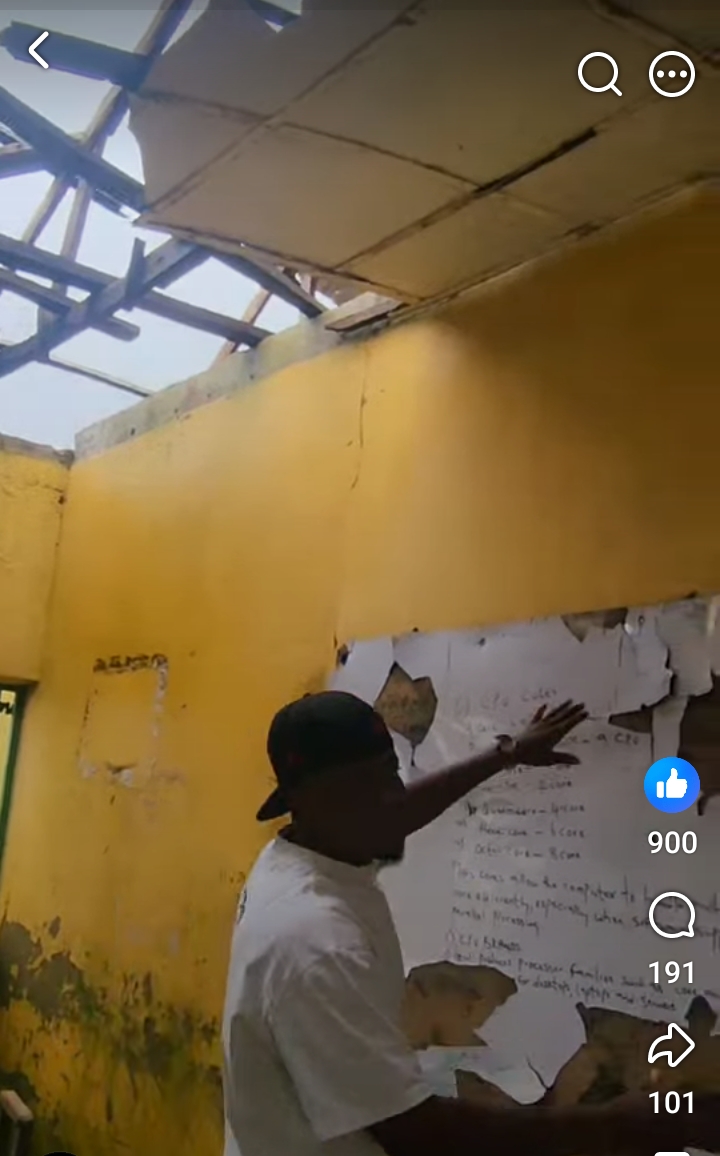
Biqlion’s tour offered a disturbing first-hand view of learning environments in which Nigerian children are expected to acquire the foundation for their future. The images and accounts emerging from the tour have renewed questions about how Nigeria prioritises public resources while basic education infrastructure continues to deteriorate.
The disclosure has also added a new dimension to the ongoing debate over the controversial ₦110 billion figure, raising a provocative national question: ₦110 billion for votes, or ₦110 billion for revitalising Nigeria’s public primary schools?
The question is particularly significant because Nigeria’s primary education system continues to face serious infrastructure challenges. A World Bank assessment found that about 48 per cent of public primary classrooms in Nigeria were dilapidated, highlighting the scale of the problem confronting the nation’s youngest learners.
For Biqlion, the school tour appears to have transformed what is often presented as a budgetary or political debate into a question of human development.
Behind every dilapidated classroom is a Nigerian child. Behind every broken desk is a pupil whose learning environment has been compromised. Behind every leaking roof is a generation being asked to dream of a better Nigeria while studying in conditions that should no longer be tolerated.
The contrast is difficult to ignore.
Nigeria routinely mobilises enormous financial resources around elections and political activities, yet many public primary schools still struggle with basic facilities such as classrooms, desks, toilets, water, electricity and teaching materials.
This raises a fundamental question of national priorities: What kind of country invests heavily in winning elections but fails to invest adequately in educating the children who will inherit the country?
Biqlion’s intervention is therefore more than an artist’s school tour. It is a visual indictment of a system that has allowed poor infrastructure in basic education to become normalised.
The ₦110 billion debate should consequently go beyond political arguments. It should force Nigerians to examine what could be achieved if substantial public resources were redirected towards rebuilding schools, equipping classrooms, supporting teachers and guaranteeing every child a safe and dignified learning environment.
The issue is not whether Nigeria has the resources to fix its primary schools. The bigger question is whether those resources are being directed towards the priorities that matter most to the Nigerian people.
As Biqlion’s tour exposes classrooms in need of urgent attention, one question should remain at the centre of the national conversation:
If ₦110 billion can be contemplated for political purposes, why can’t Nigeria find the political will to give its children decent classrooms?
Nigeria’s children should not have to wait for another election before their schools become a priority.
Biqlion’s School Tour Raises ₦110bn Question: Votes or Classrooms?

- Advertisement -

