


WASHINGTON, August 31, 2026 — A new sworn declaration filed by the Federal Bureau of Investigation (FBI) in a long-running Freedom of Information Act (FOIA) case has renewed scrutiny of records concerning Nigerian President Bola Ahmed Tinubu and an investigation into drug-trafficking activities in the United States.
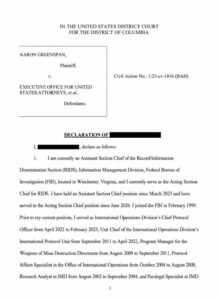
The declaration, filed on August 28, 2026, forms part of the proceedings in Aaron Greenspan v. Executive Office for United States Attorneys, et al., Civil Action No. 1:23-cv-01816 (BAH) before the U.S. District Court for the District of Columbia.
According to the document provided, the FBI official who made the declaration says he currently serves as Acting Section Chief of the Bureau’s Record/Information Dissemination Section (RIDS), which handles requests for access to FBI records under the FOIA and Privacy Act.
The official states that he is familiar with the FBI’s handling of Greenspan’s FOIA requests and that the declaration is submitted in support of the government’s position in the litigation.
FBI: Records were compiled during drug-trafficking investigation
A key issue in the latest filing is the FBI’s description of the records being withheld or redacted.
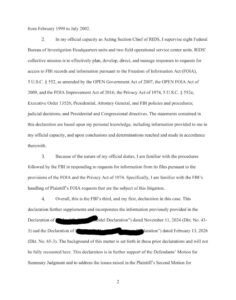
The Bureau states that the “responsive records herein were compiled in furtherance of the FBI’s investigation of multiple individuals for drug trafficking crimes.”
That statement is significant because it places the requested records squarely within a law-enforcement investigation, rather than treating them simply as ordinary personal records.
The latest development follows a April 8, 2025 ruling by U.S. District Judge Beryl Howell, in which the court found that the U.S. Department of Justice had already officially acknowledged that Tinubu was a subject of a criminal investigation involving the FBI and DEA. The court said that public DOJ filings incorporated an affidavit describing an investigation into proceeds of a Chicago heroin-distribution organization and information concerning Tinubu.
The court specifically concluded that the prior public disclosure was sufficient to defeat the FBI and DEA’s attempt to use a so-called Glomar response—a mechanism allowing an agency to refuse to confirm or deny whether responsive records exist.
What the court actually determined
The distinction is important.
The new FBI declaration itself does not constitute a new criminal charge against Tinubu, nor does it establish that he was convicted of a drug offence.
Rather, the court had already determined in 2025 that the DOJ’s public filings constituted an official acknowledgment that Tinubu was one subject of a criminal investigation involving, among other agencies, the FBI and DEA.
The court further held that the FBI and DEA could no longer rely on a Glomar response to conceal the existence of that investigation because the fact of the investigation had already been officially acknowledged.
The controversy over the FBI records
The latest filing therefore becomes important in the continuing battle over what portions of the underlying investigative records should be released.
The FBI says the records were compiled in connection with investigations of multiple individuals for drug-trafficking crimes and relies on law-enforcement exemptions to justify withholding or redacting portions of the material.
The dispute is not simply about whether records exist. It concerns how much of those records can legally be disclosed under FOIA, including information protected for privacy, investigative-method and other law-enforcement reasons.
Reports on the August 28 proceedings indicate that Tinubu has intervened in the case and is opposing broader disclosure, arguing that release of investigative material would infringe his privacy interests.
A decades-old investigation returns to the spotlight
The case traces back to records concerning a U.S. investigation into a Chicago-area heroin-trafficking operation and alleged money laundering in the early 1990s.
The litigation has attracted renewed attention because Greenspan’s FOIA requests seek FBI and DEA records concerning Tinubu, including investigative materials relating to that period.
The 2025 judgment is particularly consequential because Judge Howell rejected the government’s position that the existence of the Tinubu investigation could still be treated as secret. She found that DOJ’s own public court filings had already officially acknowledged the investigation.
What this does — and does not — prove
The latest development should therefore be reported precisely.
It does establish that:
The FBI has sworn that the responsive records were compiled during investigations of multiple individuals for drug-trafficking crimes.
A U.S. federal court previously determined that DOJ had officially acknowledged that Tinubu was a subject of a criminal investigation involving the FBI and DEA.
The litigation over access to those investigative records remains active.
It does not, by itself, establish that:
Tinubu was convicted of heroin trafficking;
Tinubu has been charged with a drug-trafficking offence in the United States; or
every record in the FBI’s possession concerning the investigation implicates him in criminal conduct.
The distinction between being investigated, being accused, being charged and being convicted remains critical.
Nevertheless, the latest FBI filing represents a significant development in a case that has kept questions surrounding the historical U.S. investigation of Nigeria’s president before the courts.
The central question now is no longer simply whether an investigation involving Tinubu was officially acknowledged. A federal judge has already answered that question. The increasingly consequential question is how much of the underlying FBI and DEA records the public will ultimately be allowed to see.


