

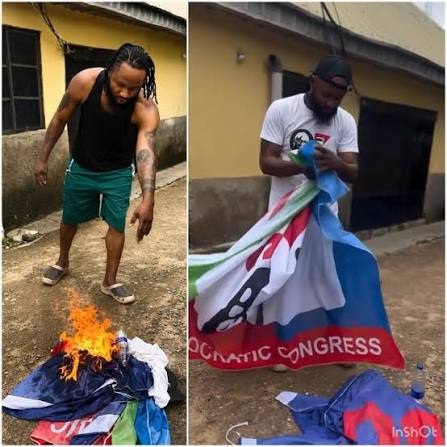
A social media personality known as Flag Boy NG has reportedly burned Nigeria Democratic Congress flags and declared an end to his support for the party’s presidential candidate, Peter Obi, in a development that has sparked mixed reactions among supporters and critics of the emerging opposition platform.
Footage of the incident was shared online by High Chief Lawrence Igbins Okoro and quickly attracted attention because of Flag Boy NG’s previous public association with Obi and the NDC.
In the video, the individual was shown setting NDC flags ablaze, apparently signalling his decision to withdraw his support for the party ahead of the 2027 general elections.
Flag Boy NG subsequently shared the footage with a brief “well done” message, further fuelling speculation about his political position and the reasons behind the dramatic gesture.
The incident has generated different reactions within the opposition movement, with some supporters dismissing the development as insignificant while others questioned what could have prompted the change in allegiance.
The NDC War Room, an online support structure associated with the party, sought to play down the incident, describing it as “one flag boy down, many up.”
The response appeared designed to reassure supporters that the action of an individual should not be interpreted as evidence of a broader decline in support for Obi or the NDC.
The group maintained that the movement was larger than any individual personality and that supporters remained committed to the party’s political project.
The incident has nevertheless highlighted the growing influence of social media personalities in Nigerian politics.
In recent years, content creators, online activists and political influencers have become increasingly important in shaping political narratives, mobilising supporters and communicating campaign messages.
Unlike traditional party structures, however, social media followings are often built around individual personalities rather than formal political organisations. This can create challenges for political movements when prominent online supporters change their positions or publicly withdraw their backing.
The latest development comes as the NDC intensifies preparations for the 2027 presidential election, with Obi and former Kano State Governor Rabiu Kwankwaso emerging as the party’s presidential and vice-presidential candidates.
The Obi-Kwankwaso ticket is being presented by its supporters as an attempt to build a broad national coalition capable of challenging the ruling All Progressives Congress.
Obi’s political support has been particularly strong among young Nigerians and social media users, making digital platforms a major component of the campaign environment surrounding his political movement.
Consequently, incidents involving high-profile online supporters can attract disproportionate attention even when their individual political influence is difficult to measure.
The Flag Boy NG controversy has also revived concerns about the role of content creators in political movements.
An NDC spokesperson recently called on the party to distance itself from individuals allegedly presenting themselves as activists when their primary role appeared to be creating online content for personal visibility.
The spokesperson argued that the party needed clearly defined structures and authorised representatives as the 2027 campaign becomes more intense.
The criticism reflects a broader challenge facing political parties in the digital era: determining how to benefit from the enormous reach of online creators without allowing individual personalities to overshadow the organisation or create confusion about official party positions.
Meanwhile, other NDC supporters have continued to display the party’s flags publicly, apparently seeking to demonstrate that the movement remains active despite the controversy.
Images circulating online have shown supporters proudly raising NDC flags at public gatherings, reinforcing the argument from party loyalists that one individual’s decision cannot determine the strength of a nationwide political movement.
There has also been confusion over the identity of the person shown burning the flags, with at least one social media account reportedly denying that the individual represented the identity attributed to him and reaffirming support for the NDC.
The conflicting claims have added another layer to the online controversy and made it difficult to establish the full circumstances surrounding the video without further clarification from the individual involved.
Political observers say such incidents are likely to become increasingly common as the 2027 elections approach and political divisions intensify online.
Supporters and opponents of major candidates are expected to use social media videos, photographs and personal statements to reinforce competing narratives about the strength or weakness of political movements.
For the NDC, the immediate response has been to insist that its political project extends beyond individual influencers.
The party’s supporters argue that political movements should be judged by their organisation, policies, candidates and ability to mobilise voters rather than by the actions of individual content creators.
The episode nevertheless provides an early indication of how intensely contested the digital space could become during the 2027 election cycle.
Whether Flag Boy NG’s decision represents a genuine political realignment or simply an isolated social media controversy remains unclear.
What is clear is that the burning of the NDC flags has generated significant discussion online and provided another glimpse into the increasingly personal and highly charged nature of Nigerian political campaigning.
As the election approaches, the NDC will have to balance the enthusiasm generated by its online supporters with the need to build a disciplined political structure capable of sustaining its campaign beyond individual personalities.


