

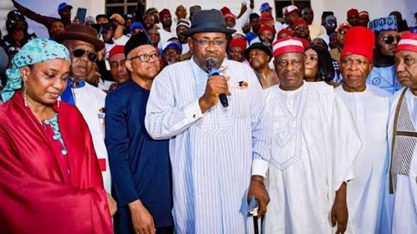
The Nigeria Democratic Congress has accused the Independent National Electoral Commission of replacing candidates nominated by the party for the 2027 general elections with names it said were neither authorised nor submitted by its leadership.
The dispute centres particularly on the Anambra State House of Assembly elections, where the NDC alleged that 10 names appeared on INEC’s published candidate list despite the party insisting that they did not emerge from its nomination process.
The development has triggered a fresh confrontation between the opposition party and the electoral commission, with the NDC demanding an urgent investigation and indicating that it may seek legal redress if the disputed names are not removed.
NDC National Chairman, Senator Moses Cleopas Zuwoghe, described the development as deeply troubling, particularly because Anambra is the home state of the party’s presidential candidate, Peter Obi.
According to Zuwoghe, the party had completed its primaries and subsequent appeals process before producing a final list of candidates. He said the list was agreed upon by relevant stakeholders, including party officials, representatives of Obi and the party’s appeals panel.
The NDC chairman maintained that he was the custodian of the access code provided to the party for uploading its candidates to the INEC nomination portal and insisted that he did not upload the disputed names.
The 10 names identified by the party are Umennaajiego Jude Ezenwa for Onitsha South 1; Akpotue Obinna Chibuike for Onitsha South 2; Nwankwo Chiemerie for Orumba North; Maduagwu Eric K for Anaocha 1; Ngoebisi Obinna for Idemili North; Isintume Charles for Njikoka 1; Nwachukwu Nonso for Nnewi South; Okeke Ifeanyi Akunne for Nnewi South 2; Nnonyelu Samson E for Ayamelum; and Azotani Chuks Francis for Dunukofia.
The party alleged that some of the disputed names were already present in the commission’s system following the monitoring of its primaries, while its own candidates were allegedly left in a pending status.
Zuwoghe called on the INEC Chairman, Professor Joash Amupitan, to investigate how the names came to be published as NDC candidates.
The party further alleged that similar problems could have occurred in other states, including Benue and Imo, and called for a wider investigation into the candidate nomination process.
The allegations, however, have been rejected by INEC.
The commission’s Chief Press Secretary and Media Adviser to the INEC Chairman, Adedayo Oketola, said INEC had no legal authority to nominate candidates for political parties or substitute candidates chosen by a party.
Oketola explained that political parties are responsible for conducting their nomination processes and submitting the particulars of their candidates through the commission’s candidate nomination portal using access credentials issued to them.
He added that activities carried out on the portal are electronically recorded, meaning that the history and source of entries can be examined through INEC’s records and audit trails.
The commission also distinguished between monitoring a party primary and nominating candidates. According to INEC, the presence of its officials at a party primary does not give the commission the authority to select candidates for the political party.
Oketola said allegations that INEC officials directly obtained nomination documents from individual aspirants and subsequently uploaded their details without party authorisation were serious and capable of being objectively verified.
He said the commission would examine records relating to the constituencies identified by the NDC and urged the party to provide any evidence implicating specific INEC officials in unauthorised interference.
The electoral commission also stressed that questions concerning who legitimately emerged from a party primary, the effect of internal appeals and any subsequent alteration of nomination outcomes must be resolved within the framework of the Electoral Act 2026 and other applicable regulations.
The dispute comes at a particularly sensitive stage of preparations for the 2027 elections, as political parties race to complete candidate nomination and verification processes.
Candidate lists are crucial because they determine who will appear on the ballot and represent political parties in the elections. Any disagreement over the authenticity of a candidate can therefore have significant political and legal consequences.
For the NDC, the controversy is especially important in Anambra, a state where Peter Obi enjoys substantial political influence and which the party regards as strategically significant.
The disagreement also places renewed attention on the transparency and reliability of INEC’s electronic nomination system. If the NDC’s allegations are substantiated, questions would arise over how unauthorised entries could have appeared on an official candidate list. Conversely, if the disputed names resulted from legitimate submissions or procedural actions, the party would have to explain how its internal nomination records differed from those reflected on the commission’s platform.
INEC has maintained that the evidence required to resolve the dispute exists within its electronic and documentary records.
The commission has therefore indicated that the matter should be settled through verification rather than political accusations.
The NDC, meanwhile, has vowed to defend what it considers its legitimate candidates and is preparing to explore legal options.
With the 2027 elections approaching, the dispute has become an early test of confidence between one of the emerging opposition parties and the country’s electoral management body.
The outcome of the investigation could determine whether the disputed candidates remain on the ballot or whether changes will be made to reflect the NDC’s officially recognised nominees.
For now, both sides remain sharply divided over how the names appeared on the candidate list. While the NDC describes the development as an attempt to undermine its electoral prospects, INEC insists that it cannot nominate candidates for political parties and has promised to examine its records to establish what actually occurred.


