

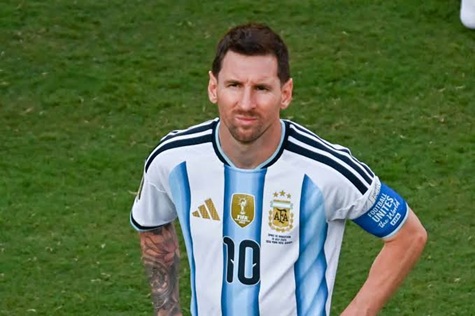
Lionel Messi has announced his retirement from international football, bringing an extraordinary 21-year career with the Argentina national team to an emotional close.
The 39-year-old Argentina captain announced his decision on Monday, ending a journey that began with his senior international debut in 2005 and ultimately established him as the country’s most-capped player and all-time leading scorer.
Messi leaves the national team with 207 appearances and 125 goals, records that place him at the top of Argentina’s international football history. His career also included four major senior international titles, most notably the 2022 FIFA World Cup in Qatar and Copa América triumphs in 2021 and 2024.
His decision comes just weeks after Argentina reached the 2026 World Cup final, where they were defeated by Spain. The match proved to be Messi’s final appearance for the national team.
In an emotional statement posted on social media, Messi said the decision was painful but acknowledged that he believed the time had come to close the chapter.
He reflected on the sacrifices made throughout his international career, stressing that he had always given everything to the Argentina shirt and fought to make supporters proud.
The retirement marks the end of a remarkable transformation in Messi’s relationship with the national team.
For years, his Argentina career was defined as much by disappointment as by individual brilliance. He lost the 2014 World Cup final to Germany and suffered defeats in major Copa América finals before finally ending the long wait for a senior international trophy in 2021.
That breakthrough changed everything.
Messi subsequently led Argentina to victory at the 2022 World Cup, producing one of the defining performances of his career as the South American giants defeated France on penalties in a dramatic final in Qatar.
He followed that success by helping Argentina retain its continental dominance with another Copa América triumph in 2024.
His final World Cup campaign in 2026 ended differently. Argentina reached the final again but fell short against Spain, leaving Messi with a runner-up medal in his final appearance at football’s biggest tournament.
Despite the disappointment, his international legacy had already been secured.
Messi also acknowledged the emergence of younger players within the Argentina squad, indicating that he believes the next generation deserves the opportunity to establish itself.
His departure leaves Argentina without the player who has been the central figure of its football identity for more than two decades.
The Argentine Football Association paid tribute to Messi, thanking him for the extraordinary contribution he made to the national team. Tributes have also come from football organisations, teammates and supporters around the world.
The retirement also closes one of the longest and most decorated international careers in modern football.
Messi represented Argentina at six World Cups and leaves the tournament as one of its most prolific scorers. His international achievements include the 2008 Olympic gold medal, the 2021 and 2024 Copa América titles, the 2022 Finalissima and, above all, the 2022 World Cup.
His journey was not without setbacks. In 2016, following Argentina’s defeat to Chile in the Copa América final, Messi briefly announced his international retirement before reversing the decision.
He returned to lead the team through its most successful era in decades.
Now, however, Messi says the time has come to step away permanently.
The decision follows a difficult period personally as well as professionally. Messi’s father, Jorge Messi, died earlier in August at the age of 68. Reports indicate that Messi had already been considering retirement after the 2026 World Cup final, with his father’s death reinforcing his decision.
Although his international career is over, Messi’s football career is not.
The eight-time Ballon d’Or winner will continue playing club football with Inter Miami in Major League Soccer, where he remains under contract.
For Argentina supporters, however, his role will now change dramatically. The player who once carried the nation’s hopes on his shoulders will become a spectator, watching from the stands as a new generation attempts to continue the legacy he helped build.
From the heartbreak of early international defeats to the glory of Copa América and World Cup victories, Messi’s story with Argentina has become one of perseverance, redemption and extraordinary achievement.
He leaves behind 207 appearances, 125 goals and a collection of trophies that finally silenced many of the doubts that once surrounded his international career.
More importantly, he leaves as a symbol of Argentine football.
After more than two decades in the famous blue-and-white shirt, one of football’s greatest chapters has reached its final page.
Messi may no longer play for Argentina, but his influence on the national team—and on an entire generation of supporters—is unlikely to disappear anytime soon.


