

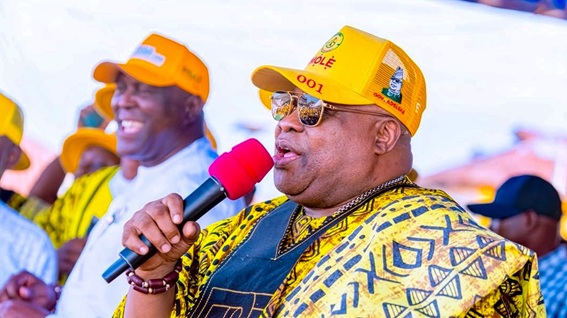
Osun State Governor, Ademola Adeleke, has intensified efforts to reconcile political leaders across the state, reaching out to former governors Bisi Akande, Olagunsoye Oyinlola and Rauf Aregbesola as the state marked its 35th anniversary.
Adeleke’s latest peace initiative comes in the aftermath of the recent governorship election, which he said had left political divisions and wounds that needed to be addressed through dialogue and reconciliation.
According to a statement by the governor’s spokesperson, Olawale Rasheed, Adeleke used the anniversary celebration as an opportunity to engage former leaders and discuss ways of restoring political harmony in the state.
The governor reportedly spoke extensively with former Governor and former National Chairman of the All Progressives Congress, Bisi Akande, briefing him on his reconciliation efforts and urging political leaders to support a post-election peace agenda.
Adeleke also contacted former Governors Olagunsoye Oyinlola and Rauf Aregbesola, explaining his desire to reconcile the various political groups and promote unity among the people of Osun.
The governor congratulated the former leaders on the 35th anniversary of the creation of Osun State and acknowledged their contributions to the development of the state.
The outreach is part of what the governor described as an effort to heal political divisions following a period of intense electoral competition.
Adeleke also attempted to contact former Governor Gboyega Oyetola and the All Progressives Congress governorship candidate, Bola Oyebamiji, by telephone. However, according to the statement, neither had responded as of the time of the report.
The governor’s message, according to reports, was that the election should now be put behind the people of Osun and that political differences should give way to reconciliation.
“There is no victor, no vanquished. The election is over; it is now time to heal, reconcile and unite our people,” Adeleke was quoted as saying.
The appeal for reconciliation comes against the backdrop of a politically competitive environment in Osun, where successive administrations have been associated with intense rivalry between major political blocs.
Akande, Oyinlola, Aregbesola and Oyetola have each played significant roles in the state’s political history, making their involvement potentially important to any broader effort to reduce political tensions.
Adeleke’s decision to reach across party lines could therefore represent an attempt to establish a wider political consensus around the state’s development beyond partisan interests.
The governor has also linked the reconciliation effort to the need to heal divisions arising from pre-election violence and other tensions associated with political competition.
The latest initiative suggests that the administration is seeking to move the political conversation away from electoral rivalry and towards governance and development.
Political reconciliation could also help create a more stable environment for the state government to pursue its programmes, particularly if major political actors are willing to cooperate on issues affecting residents.
However, successful reconciliation will depend on more than telephone calls and public appeals.
It will require sustained engagement among political leaders, respect for differing political views and a willingness to address grievances that may have emerged during the electoral process.
The willingness of opposition figures to participate will also be crucial.
While Adeleke has reached out to several former governors, the reported absence of a response from Oyetola and Oyebamiji suggests that the reconciliation process may still face political hurdles.
Nevertheless, the governor’s approach could provide an opportunity for Osun’s political class to establish a new tone after a highly competitive electoral period.
The 35th anniversary of the state offers a symbolic moment for such an initiative, allowing political leaders to focus on Osun’s shared identity and long-term interests rather than their differences.
Osun was created in 1991 and has since produced several political administrations representing different parties and ideological traditions. The state’s political history has therefore been shaped by competition as well as periods of cooperation.
For residents, the immediate expectation is that political reconciliation will translate into a more peaceful environment and stronger attention to governance.
Adeleke’s appeal also carries a broader message for Nigerian politics: electoral contests eventually end, but the communities affected by political divisions remain.
As the governor continues his outreach, the success of the initiative will depend on whether former leaders and rival political camps are prepared to engage in good faith.
For now, Adeleke has extended the hand of reconciliation.
The next step lies with the leaders he has contacted—and whether Osun’s political class can turn the governor’s call for “no victor, no vanquished” into a lasting culture of peace and cooperation.


