

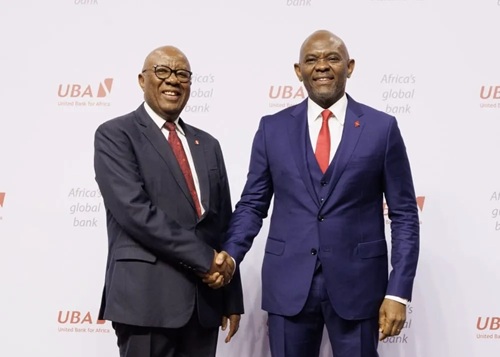
United Bank for Africa Plc has formally welcomed Emmanuel Nnorom as its new Group Chairman following the retirement of Tony Elumelu from the bank’s board after 12 years at the helm.
Nnorom assumed the chairmanship on August 21, 2026, succeeding Elumelu, whose retirement followed the completion of the maximum 12-year tenure prescribed for non-executive directors under Central Bank of Nigeria corporate governance guidelines.
The transition marks the end of an important chapter in the history of one of Africa’s largest financial institutions, with Elumelu credited with overseeing a period of significant expansion and strengthening of UBA’s position as a pan-African banking group.
UBA announced Elumelu’s retirement and Nnorom’s appointment following a meeting of its board of directors in July. The bank described the transition as part of its commitment to sound corporate governance and board independence.
Nnorom is a long-serving non-executive director of UBA and brings extensive experience within the financial and corporate sectors to his new role.
His appointment is expected to provide continuity at the board level as the bank continues to pursue its expansion strategy across Africa and international financial centres.
Under Elumelu’s chairmanship, UBA expanded its operations to 20 African countries, alongside its presence in four international financial centres. The bank currently serves more than 50 million customers, reflecting the scale of the institution he leaves behind.
In his farewell message, Elumelu said his tenure had been guided by a broader vision of building an African institution capable of competing globally while remaining committed to the continent’s economic development.
He described UBA as an institution that had grown beyond individual personalities and stressed that successful leadership should involve preparing an organisation for continuity beyond the tenure of any particular leader.
Elumelu also expressed confidence in his successor, saying Nnorom possesses the experience, leadership capacity and deep understanding of UBA required to guide the group into its next phase. He called on shareholders, customers, partners and employees to extend the same support to Nnorom that they had given him.
The leadership transition comes at a significant period for Nigeria’s banking industry, with financial institutions undergoing major changes in response to evolving regulatory requirements, technological transformation and increasing competition across Africa.
For UBA, maintaining growth while strengthening corporate governance will remain a major priority under the new chairman.
The bank’s extensive continental network also means that Nnorom will oversee an institution operating across diverse economic and regulatory environments. Its African expansion has positioned UBA as one of the Nigerian banks with the widest international footprint.
Beyond traditional banking, the group has increasingly invested in digital banking, financial technology and cross-border payment solutions as African economies become more interconnected.
The change in leadership is therefore unlikely to signal a departure from UBA’s broader strategic direction. Instead, the transition is expected to combine institutional continuity with new leadership at the board level.
Elumelu’s departure also reflects the increasing importance of regulatory compliance in Nigeria’s banking sector. The CBN’s limits on the tenure of non-executive directors are designed to promote board renewal, independence and stronger corporate governance.
His exit, consequently, is not being presented by UBA as a crisis or abrupt leadership change but as a planned succession process following the completion of his permitted tenure.
For Elumelu, the transition brings to a close 12 years as chairman of UBA, although his broader association with the institution spans several decades.
For Nnorom, the appointment begins a new chapter with responsibility for steering one of Africa’s major banking groups through an increasingly competitive financial environment.
As UBA welcomes its new chairman, attention will now turn to how Nnorom builds on the foundations established under Elumelu while positioning the group for its next phase of growth.
The leadership change ultimately underscores a central principle of corporate governance: strong institutions must be capable of outliving individual leaders and sustaining their progress through orderly succession.


