

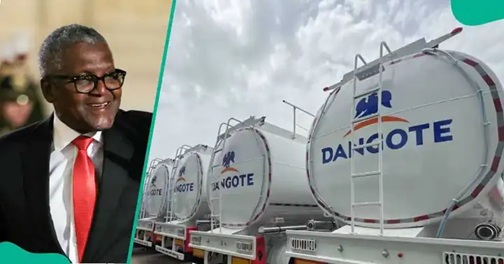
The Dangote Petroleum Refinery has expanded its free petroleum products delivery initiative to four additional states as part of efforts to reduce distribution costs for independent petroleum marketers and create room for lower petrol prices across Nigeria.
The newly included states are Kano, Imo, Anambra and Nasarawa, extending the programme beyond its initial coverage of Lagos, Ogun, Rivers, Kaduna, Delta and the Federal Capital Territory.
The refinery said the initiative is designed to address one of the major components of petrol pricing—the cost of transporting petroleum products from the refinery to different parts of the country.
By absorbing the cost of delivery for eligible marketers, the refinery expects to reduce their logistics expenses and potentially create additional room for lower pump prices for consumers.
The expansion is particularly significant because the four new states are located across different parts of the country, with Kano providing wider access to the northern market while Imo, Anambra and Nasarawa extend the programme into the South-East and North-Central regions.
The initiative was initially introduced with deliveries to Abuja, Lagos, Ogun, Rivers, Kaduna and Delta states. The latest expansion increases the geographical reach of the programme and represents another attempt by the Dangote refinery to strengthen domestic fuel distribution.
Under the arrangement, eligible independent petroleum marketers can obtain products directly from the refinery while benefiting from free transportation. Reports on the expanded programme indicate that petrol supplied under the arrangement will be priced at about N1,165 per litre, with qualifying marketers also receiving a 10-day credit facility.
The reported arrangement requires participating marketers to meet specified purchasing conditions, including a minimum volume requirement, before accessing the benefits.
The refinery’s intervention comes amid continuing concerns over the high cost of transporting petrol across Nigeria.
Because of the country’s size and uneven distribution of petroleum infrastructure, transportation expenses can significantly influence the price consumers pay at filling stations, particularly in areas far from coastal fuel terminals and refineries.
Reducing those logistics costs could therefore have a noticeable impact on petrol prices if marketers pass the savings on to consumers.
The development is also significant for the broader transformation of Nigeria’s downstream petroleum sector following the removal of petrol subsidy in 2023.
With the government no longer maintaining the previous subsidy regime, petroleum marketers have increasingly had to operate within a market-driven pricing environment.
The Dangote refinery’s growing domestic supply has consequently become an important part of efforts to reduce Nigeria’s dependence on imported refined petroleum products.
The 650,000-barrel-per-day refinery has progressively increased its role in supplying the domestic market while also positioning itself as a major exporter of refined petroleum products. Reuters recently reported that the refinery has secured a $1 billion underwriting programme ahead of a planned initial public offering.
Industry stakeholders have welcomed the expansion of the free-delivery initiative, although some have called for the programme to cover more states.
The Independent Petroleum Marketers Association of Nigeria has urged the refinery to extend direct fuel deliveries further into northern states, arguing that broader coverage could help reduce regional differences in pump prices and ease pressure on consumers.
For motorists and businesses, the potential benefit of the initiative will ultimately depend on how much of the reduction in distribution costs is reflected in retail petrol prices.
If marketers pass the savings through to consumers, the programme could provide some relief to households and businesses still struggling with high transportation and operating costs.
However, the initiative alone is unlikely to resolve all the challenges affecting petrol prices in Nigeria. Crude oil prices, exchange-rate movements, taxation, regulatory costs, supply conditions and marketers’ margins can also influence pump prices.
Nevertheless, the expansion represents another major development in Nigeria’s evolving petroleum market.
As Dangote Refinery extends its free delivery network, attention will now focus on whether the initiative can produce sustained reductions in petrol prices and whether additional states will eventually be brought into the programme.
For millions of Nigerian consumers, the most important measure of its success will be simple: whether cheaper distribution ultimately translates into cheaper petrol at the pump.


