

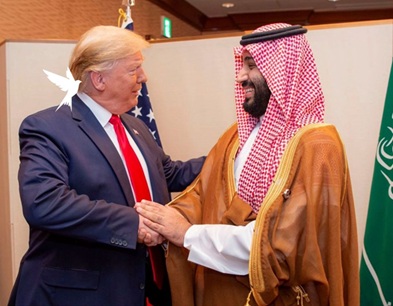
United States President Donald Trump has announced that a proposed civilian nuclear agreement between the United States and Saudi Arabia will only proceed if the Gulf kingdom formally joins the Abraham Accords and recognizes Israel, linking one of Washington’s most significant strategic partnerships in the Middle East to regional diplomatic normalization.
Trump disclosed that negotiations on the civilian nuclear cooperation agreement have been ongoing for about a month between the U.S. Department of Energy and Saudi Arabian officials. According to him, the proposed arrangement is strictly limited to peaceful civilian purposes and will not permit Saudi Arabia to enrich nuclear material, a key provision aimed at preventing the proliferation of nuclear weapons.
In a statement posted on his Truth Social platform, the U.S. President stressed that the agreement differs significantly from previous nuclear arrangements involving countries such as Iran and the United Arab Emirates. He emphasized that the Saudi deal excludes uranium enrichment and other sensitive nuclear activities that could potentially be diverted for military use.
“The agreement will be ratified, but it is entirely contingent upon Saudi Arabia joining the Abraham Accords,” Trump said, making it clear that diplomatic recognition of Israel remains a central condition for the deal.
The announcement underscores the Trump administration’s continued commitment to expanding the Abraham Accords, the landmark diplomatic initiative first launched in 2020 that established formal relations between Israel and several Arab nations, including the United Arab Emirates, Bahrain, Morocco, and Sudan. Washington has long regarded Saudi Arabia’s participation as the most significant remaining milestone for the regional normalization effort.
Israeli Prime Minister Benjamin Netanyahu welcomed Trump’s announcement, describing the prospect of Saudi Arabia joining the Abraham Accords as a transformative moment for the Middle East. In a statement issued by his office, Netanyahu said Saudi recognition of Israel would represent a “historic leap forward” for regional peace, economic cooperation, and collective security.
The potential agreement has drawn considerable international attention because Saudi Arabia is one of the Middle East’s most influential political and economic powers and the custodian of Islam’s two holiest sites. Analysts believe normalization between Riyadh and Jerusalem could fundamentally reshape regional alliances and strengthen cooperation on trade, technology, energy, and defense.
However, Saudi Arabia has consistently maintained that any formal recognition of Israel remains tied to progress toward establishing an independent Palestinian state based on international agreements. While Riyadh has engaged in indirect cooperation with Israel on several regional security matters, it has not officially normalized diplomatic relations.
The proposed civilian nuclear agreement is also viewed as a strategic effort by Washington to deepen its partnership with Saudi Arabia amid increasing competition for influence in the Gulf region. By offering civilian nuclear cooperation under strict safeguards, the United States aims to strengthen bilateral ties while ensuring that Saudi Arabia’s nuclear ambitions remain within internationally accepted non-proliferation standards.
Observers say Trump’s decision to make the nuclear agreement conditional on Saudi Arabia joining the Abraham Accords raises the diplomatic stakes for both Washington and Riyadh. While the move could accelerate efforts toward broader Arab-Israeli normalization, it may also complicate negotiations given Saudi Arabia’s longstanding position on the Palestinian issue.
As discussions continue, the proposed agreement is expected to remain a focal point of Middle East diplomacy, with governments across the region closely monitoring whether the promise of civilian nuclear cooperation will be enough to persuade Saudi Arabia to take the historic step of recognizing Israel.


