

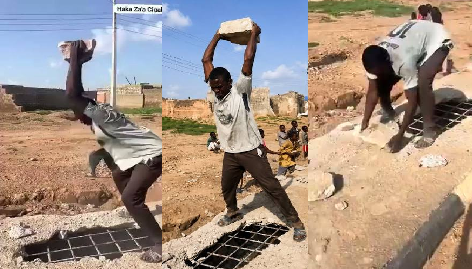
Public outrage has followed the circulation of footage showing Nigerian youths allegedly dismantling a drainage structure to remove iron rods for sale as scrap metal.
The incident, reportedly recorded in northern Nigeria, shows the men using rocks and other tools to break apart the concrete structure and extract metal reinforcement bars embedded within it.
The footage has sparked widespread criticism, with Nigerians expressing concern that the destruction of public infrastructure for relatively small financial gains could expose entire communities to serious risks.
Commentators said the incident demonstrates how the activities of some scrap-metal scavengers can undermine infrastructure built with public funds and ultimately create additional costs for taxpayers.
One commentator, identified as G. S. Babatunde, described the development as a tragedy, warning that the destruction of drainage infrastructure could contribute to flooding, accidents and road collapses, potentially putting families and other road users at risk.
Drainage systems play a crucial role in managing stormwater, particularly during Nigeria’s rainy season. When drainage channels are damaged or blocked, rainwater can accumulate around roads and residential areas, increasing the risk of flooding and erosion.
The removal of reinforcement rods from concrete drainage structures could also weaken the infrastructure and cause sections of the facility to collapse.
The incident has therefore raised broader questions about the protection of public infrastructure and the growing activities of individuals who dismantle government-owned assets for scrap.
Some Nigerians reacting to the footage also questioned why security personnel or local authorities did not intervene while the alleged destruction was taking place.
The visibility of the activity in a public area has prompted concerns about enforcement and whether authorities are doing enough to prevent the theft and destruction of public property.
The incident is not isolated.
Authorities in different parts of Nigeria have previously arrested suspected scavengers accused of removing metal components from bridges, roads, electricity infrastructure, telecommunications facilities and other public assets.
In one recent case, 27 suspects were reportedly arrested around the Festac-Alakija Bridge in Lagos in connection with activities involving the vandalism or theft of public infrastructure.
The growing concern has prompted calls for stronger enforcement against the illegal removal of public assets.
Scrap metal itself is a legitimate commercial commodity, providing income for thousands of Nigerians involved in recycling and waste recovery. However, problems arise when individuals obtain scrap materials by destroying infrastructure or stealing components from public facilities.
Authorities therefore face the challenge of distinguishing legitimate recycling activities from criminal vandalism.
Community leaders and residents have also been urged to report the destruction of public infrastructure before significant damage is done.
The problem is particularly serious because the immediate financial benefit gained from selling stolen metal can be far smaller than the eventual cost of replacing the damaged infrastructure.
A drainage channel that costs millions of naira to construct, for example, could be weakened or destroyed for a relatively small quantity of scrap metal.
When the structure fails, however, government authorities may be forced to spend considerably more on reconstruction while residents bear the consequences of flooding and damaged roads.
The incident also highlights the socioeconomic challenges facing many young Nigerians. Some youths turn to scrap collection as a source of income because of unemployment and limited economic opportunities.
While this does not justify vandalising public property, observers argue that sustainable solutions should combine law enforcement with opportunities for legitimate employment and recycling.
Stronger regulation of scrap-metal dealers could also help authorities trace the origin of materials and prevent businesses from purchasing obviously stolen public infrastructure.
Authorities could require dealers to maintain records showing where high-value metal materials were obtained, making it easier to identify suspicious transactions.
The latest footage has therefore renewed calls for tougher measures against infrastructure vandalism, improved monitoring of public assets and greater economic opportunities for vulnerable young people.
For residents, the issue goes beyond the destruction of a single drainage structure.
Every damaged public facility can increase the risk of flooding, accidents and infrastructure failure, ultimately affecting the same communities whose resources were used to build them.
As Nigerians continue to debate the incident, the message from many commentators is clear: protecting public infrastructure must become a shared responsibility involving government agencies, communities, security personnel and responsible citizens.