

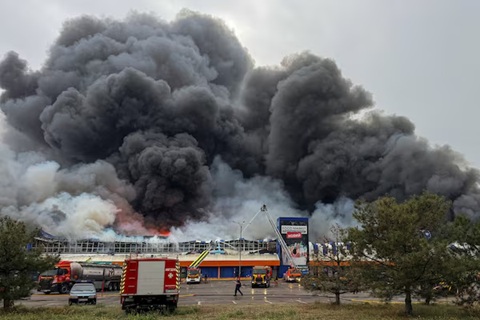
Russian strikes on Ukraine have reportedly destroyed about 90 per cent of warehouse facilities used by major retail chains, raising concerns over food distribution and supply shortages as the war continues to disrupt critical civilian infrastructure.
The scale of the destruction was highlighted by Ukrainian officials, who said repeated Russian attacks had severely damaged the logistics network supporting supermarkets and food retailers across the country.
Vysotskyi, a Ukrainian official, said approximately 90 per cent of warehouse facilities serving retail chains had been destroyed. Among the facilities reportedly lost was the last remaining Epicenter warehouse in Zaporizhia, further weakening the country’s already strained retail supply system.
The attacks have reportedly affected major supermarket chains, including ATB, Fora and Silpo. Retailers have consequently been forced to introduce restrictions on the quantities of some essential food products that individual customers can purchase.
Items reportedly subject to rationing include eggs, grains, pasta, sugar, cooking oil and canned foods. The restrictions are intended to prevent panic buying and ensure that available supplies can reach as many consumers as possible.
The destruction of warehouses has created a major logistical challenge because Ukraine’s retail system depends heavily on central distribution centres to move large quantities of food and household products from producers to supermarkets.
With many of those facilities damaged or destroyed, retailers are increasingly turning to alternative supply arrangements. One of the methods being adopted involves transporting goods directly from producers to individual stores, bypassing damaged distribution centres.
While the approach could help keep supermarkets supplied, it is considerably more expensive and less efficient than conventional distribution. Retailers may also have fewer opportunities to maintain a broad selection of products because of transportation limitations and disruptions to supply chains.
Ukrainian officials have nevertheless sought to reassure the population that the damage will not result in widespread famine.
Authorities insist that food will continue to reach major population centres despite the destruction of storage and distribution infrastructure. However, the disruption is expected to increase operating costs for retailers and could contribute to higher prices for consumers already facing the economic consequences of the war.
The situation has also reportedly been accompanied by shortages of other basic necessities in some areas, including drinking water, fuel and heating supplies.
Images circulating from affected locations have shown warehouses engulfed in flames and thick columns of smoke following missile and drone attacks. The destruction has underscored the vulnerability of civilian supply infrastructure nearly years into the conflict.
Residents in Kyiv and other affected areas have reportedly begun leaving their homes as concerns over access to essential services grow. Images of long queues of evacuees have emerged alongside reports of shortages, highlighting the growing humanitarian pressure caused by the attacks.
The latest developments come amid an intensification of strikes between Russia and Ukraine. Both sides have increasingly targeted infrastructure connected to the other’s war effort, with Ukraine also carrying out attacks against Russian military and energy-related facilities.
Some accounts have portrayed the latest Russian strikes as retaliation for Ukrainian attacks on targets inside Russia. However, the destruction of civilian-linked logistics facilities has prompted renewed concerns about the humanitarian consequences of the continuing conflict.
The disruption of food distribution illustrates how modern warfare can affect civilians even when they are not directly located on a battlefield. Warehouses, roads, energy facilities and transport networks are essential components of the food supply chain, and their destruction can have consequences far beyond the immediate impact zone.
For Ukrainian retailers, the immediate challenge is keeping stores stocked while operating with a severely damaged logistics network. Direct deliveries from producers may prevent supermarket shelves from becoming completely empty, but the additional costs and transportation difficulties could make some products more expensive and less readily available.
For consumers, the restrictions on essential goods represent another layer of hardship after years of war, displacement and economic disruption.
Ukrainian authorities continue to maintain that the country has sufficient food supplies to avoid widespread hunger. But with the reported destruction of most retail warehouse capacity, maintaining that stability will depend heavily on the ability of producers, retailers and transport operators to establish alternative distribution routes.
As Russian and Ukrainian forces continue exchanging long-range strikes, the damage to Ukraine’s civilian logistics infrastructure demonstrates the increasingly broad economic and humanitarian consequences of the war.
The coming weeks will determine whether alternative supply arrangements can adequately compensate for the destroyed warehouse network or whether prolonged disruptions will translate into deeper shortages and rising costs for Ukrainian households.