

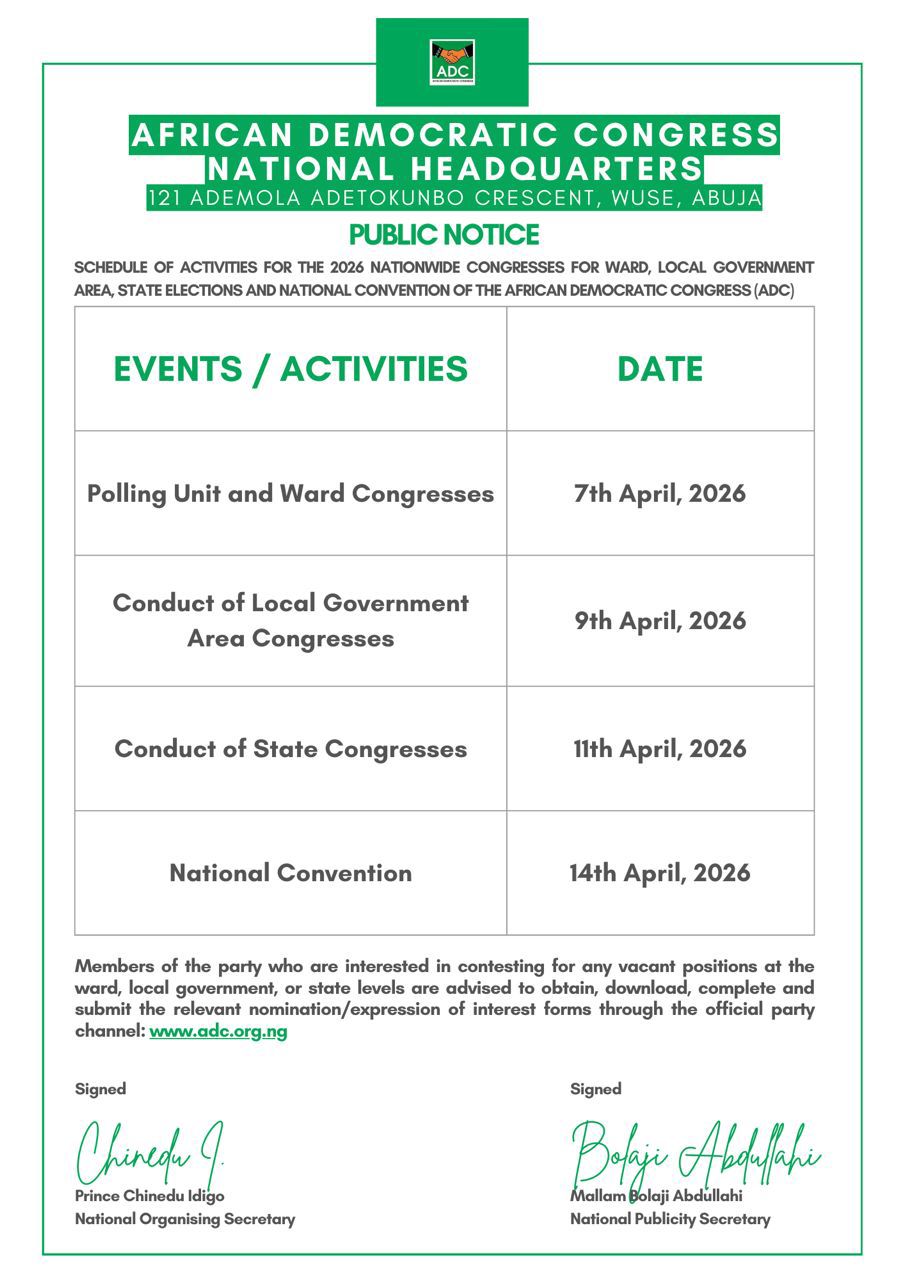
Concerns are mounting among members of the (ADC) over what many describe as excessive nomination requirements and financial charges imposed on aspirants seeking to contest for party positions at the ward, local government, and state levels.
According to the party’s nomination guidelines, aspirants must first submit an expression of interest form backed by a specified number of nominators depending on the position sought. Ward chairmanship aspirants are required to present at least 100 nominators, while other ward positions require 50 nominators. Each nominator is also expected to pay a nomination fee of ₦1,000.
In addition, aspirants must pay an expression of interest fee of ₦10,000 alongside nomination fees that vary by position. For ward-level positions, nomination fees range from ₦10,000 for other ward officers to ₦30,000 for ward chairman and ₦25,000 for ward secretary.
At the local government level, the fees rise significantly, with LGA chairmanship aspirants expected to pay ₦250,000, while secretaries are required to pay ₦200,000 and other officers ₦100,000.
State-level positions attract even higher charges. Aspirants for state chairman must pay ₦1,000,000, while the state secretary position costs ₦500,000 and other state officers ₦250,000.
Party members have expressed frustration that the nomination structure, combined with the ₦1,000 fee required from each nominator, could place a heavy financial burden on grassroots aspirants. For example, a ward chairman aspirant who must present 100 nominators paying ₦1,000 each would already incur ₦100,000 in nomination-related costs, in addition to the ₦10,000 expression of interest fee and ₦30,000 nomination fee.
Critics argue that the cumulative cost could discourage genuine grassroots participation and limit opportunities for members who lack the financial resources to meet the requirements.
Some members have also raised concerns about the potential implications for internal party control, warning that if leadership positions become largely dependent on financial strength, it could create conditions where wealthy individuals dominate the structure. According to them, when political participation becomes heavily monetized, it raises the question of whether whoever is able to spend the most money could eventually take control of the party machinery.
However, the party notes that female aspirants, youths, and persons with disabilities will pay the full expression of interest fee but only half of the nomination fee as part of measures intended to encourage inclusiveness.
The development has sparked debate within political circles over the role of financial barriers in internal party democracy, with some members questioning whether such costs could undermine broader participation in party leadership processes.


