

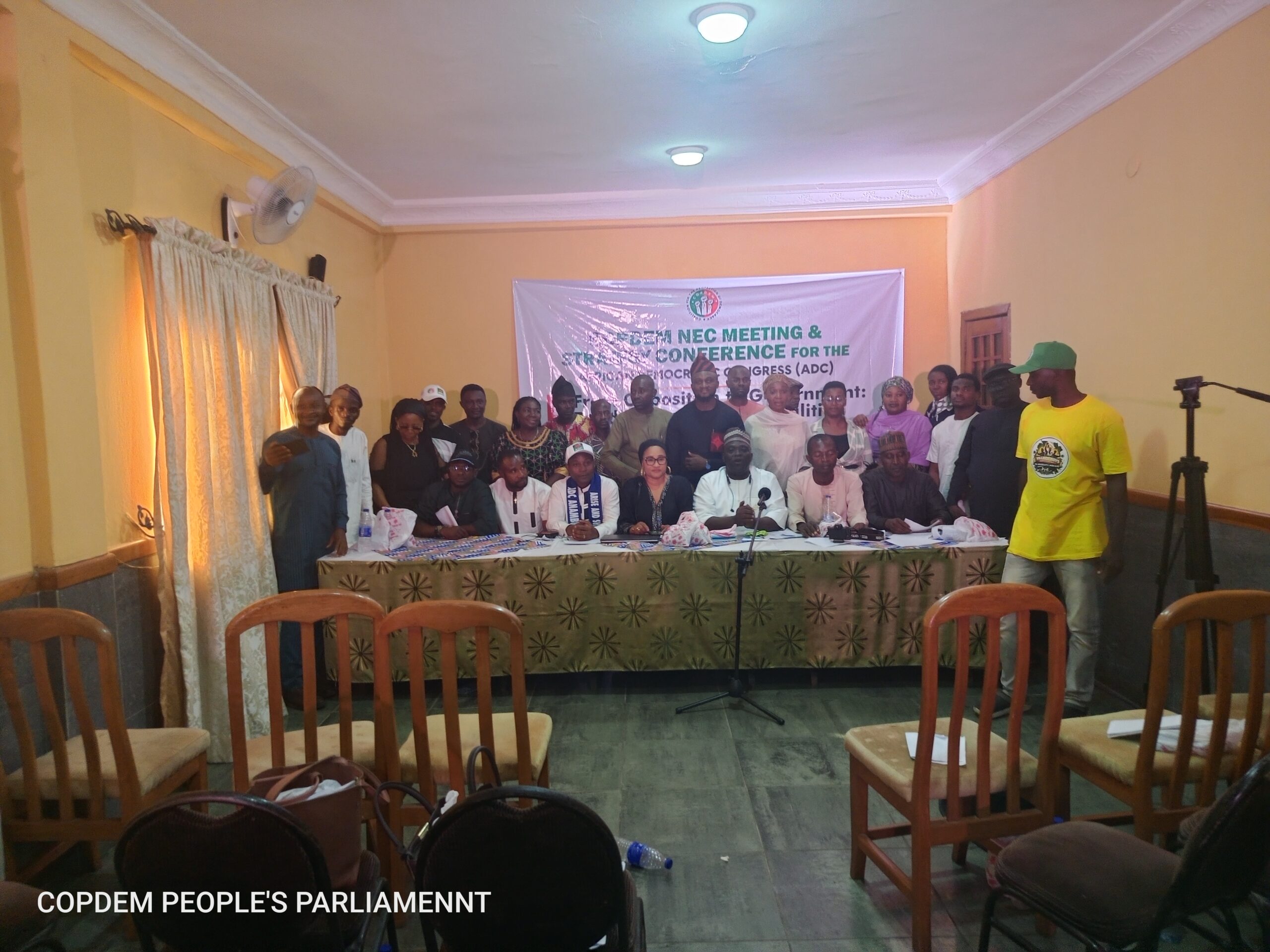
Abuja – Tuesday, 17 March 2026
Leaders, political stakeholders, civil society actors, and democratic reform advocates convened in Abuja on Tuesday, 17 March 2026, for the COPDEM National Executive Council Meeting and Strategy Conference with the African Democratic Congress (ADC).
The conference was held under the theme:
“From Opposition to Government: Building the Winning Coalition for Nigeria 2027.”
Participants engaged in extensive deliberations on Nigeria’s political trajectory and the urgent need to build a credible governing alternative capable of restoring public confidence in leadership ahead of the 2027 general elections.
The conference examined key strategic pillars necessary for a successful national campaign, including electoral mathematics, national messaging and narrative, candidate selection strategy, and institutional reforms within the party structure.
Delegates noted that Nigeria is currently facing severe economic strain, worsening insecurity, and declining public trust in political leadership. These challenges require a new leadership direction grounded in competence, credibility, national unity, and inclusive governance.
In the course of deliberations, the conference made the following observations:
Electoral Mathematics
Participants agreed that building a winning national coalition requires careful understanding of Nigeria’s electoral realities. A successful presidential campaign must mobilise broad support across regions and rekindle the political energy of key voting blocs, particularly across the Middle Belt and the Southern regions of the country, where reform-oriented voters are seeking credible leadership alternatives.
Messaging and National Narrative:
The conference emphasised that Nigeria’s political future must be anchored on a message that appeals to the shared values of the Nigerian people — fairness, unity, inclusion, and justice among the various regions of the federation.
Delegates observed that the principle of zoning and balanced leadership has historically served as a stabilising mechanism in Nigeria’s political culture, helping to sustain national unity in a diverse federation.
Candidate Selection Strategy
Participants further noted that Nigeria’s democratic experience since 1999 has been shaped by a widely accepted North–South leadership rotation principle, which has contributed to political balance within the federation.
Delegates observed that no major political party has successfully won a presidential election in Nigeria after openly disregarding the expectations of regional balance embedded in this political culture.
The conference also noted that across Nigeria today, the zoning principle is widely practiced and respected in the allocation of executive political offices, from councillorship positions to local government chairmanships and governorships across the federation.
Party Structure and Institutional Reform
Participants agreed that for the African Democratic Congress (ADC) to successfully transition from opposition into government, it must continue strengthening its internal structures, deepen internal democracy, and promote broad national inclusion within its leadership architecture.
Delegates emphasised that a party that seeks to represent all Nigerians must consistently reflect the principles of fairness, representation, and national balance in its major strategic decisions.
RESOLUTION
After extensive consultations and deliberations, participants adopted the following major political resolution regarding the 2027 presidential election:
The conference resolved that in order to build a broad, credible, and nationally accepted governing coalition, the presidential ticket of the African Democratic Congress (ADC) for the 2027 general elections should be zoned to Southern Nigeria.
This recommendation reflects the widely accepted Nigerian political tradition of North–South leadership rotation, which has helped maintain balance and stability within the federation.
Participants further noted that zoning the presidential ticket to the South would significantly strengthen the party’s ability to mobilise support across key electoral regions and consolidate a winning national coalition.
The conference emphasised that a political platform that seeks to represent all Nigerians must demonstrate the courage to uphold the principles of equity, fairness, and inclusion in leadership selection.
CONCLUSION
Participants reaffirmed their collective commitment to building a disciplined, reform-driven political movement capable of restoring MEDIA COMMUNIQUÉ
COMMUNIQUÉ ISSUED AT THE END OF THE COPDEM NEC MEETING AND STRATEGY CONFERENCE WITH THE
African Democratic Congress (ADC)
Held in Abuja – Tuesday, 17 March 2026
Leaders, political stakeholders, civil society actors, and democratic reform advocates convened in Abuja on Tuesday, 17 March 2026, for the COPDEM National Executive Council Meeting and Strategy Conference with the African Democratic Congress (ADC).
The conference was held under the theme:
“From Opposition to Government: Building the Winning Coalition for Nigeria 2027.”
Participants engaged in extensive deliberations on Nigeria’s political trajectory and the urgent need to build a credible governing alternative capable of restoring public confidence in leadership ahead of the 2027 general elections.
The conference examined key strategic pillars necessary for a successful national campaign, including electoral mathematics, national messaging and narrative, candidate selection strategy, and institutional reforms within the party structure.
Delegates noted that Nigeria is currently facing severe economic strain, worsening insecurity, and declining public trust in political leadership. These challenges require a new leadership direction grounded in competence, credibility, national unity, and inclusive governance.
In the course of deliberations, the conference made the following observations:
Electoral Mathematics
Participants agreed that building a winning national coalition requires careful understanding of Nigeria’s electoral realities. A successful presidential campaign must mobilise broad support across regions and rekindle the political energy of key voting blocs, particularly across the Middle Belt and the Southern regions of the country, where reform-oriented voters are seeking credible leadership alternatives.
Messaging and National Narrative
The conference emphasised that Nigeria’s political future must be anchored on a message that appeals to the shared values of the Nigerian people — fairness, unity, inclusion, and justice among the various regions of the federation.
Delegates observed that the principle of zoning and balanced leadership has historically served as a stabilising mechanism in Nigeria’s political culture, helping to sustain national unity in a diverse federation.
Candidate Selection Strategy
Participants further noted that Nigeria’s democratic experience since 1999 has been shaped by a widely accepted North–South leadership rotation principle, which has contributed to political balance within the federation.
Delegates observed that no major political party has successfully won a presidential election in Nigeria after openly disregarding the expectations of regional balance embedded in this political culture.
The conference also noted that across Nigeria today, the zoning principle is widely practiced and respected in the allocation of executive political offices, from councillorship positions to local government chairmanships and governorships across the federation.
Party Structure and Institutional Reform
Participants agreed that for the African Democratic Congress (ADC) to successfully transition from opposition into government, it must continue strengthening its internal structures, deepen internal democracy, and promote broad national inclusion within its leadership architecture.
Delegates emphasised that a party that seeks to represent all Nigerians must consistently reflect the principles of fairness, representation, and national balance in its major strategic decisions.
RESOLUTION
After extensive consultations and deliberations, participants adopted the following major political resolution regarding the 2027 presidential election:
The conference resolved that in order to build a broad, credible, and nationally accepted governing coalition, the presidential ticket of the African Democratic Congress (ADC) for the 2027 general elections should be zoned to Southern Nigeria.
This recommendation reflects the widely accepted Nigerian political tradition of North–South leadership rotation, which has helped maintain balance and stability within the federation.
Participants further noted that zoning the presidential ticket to the South would significantly strengthen the party’s ability to mobilise support across key electoral regions and consolidate a winning national coalition.
The conference emphasised that a political platform that seeks to represent all Nigerians must demonstrate the courage to uphold the principles of equity, fairness, and inclusion in leadership selection.
CONCLUSION
Participants reaffirmed their collective commitment to building a disciplined, reform-driven political movement capable of restoring public trust in governance and delivering competent leadership for Nigeria.
The conference concluded with a call for unity among democratic forces committed to national renewal and the emergence of a credible governing alternative for the Nigerian people.
public trust in governance and delivering competent leadership for Nigeria.
The conference concluded with a call for unity among democratic forces committed to national renewal and the emergence of a credible governing alternative for the Nigerian people.
Issued in Abuja
17 March 2026


