

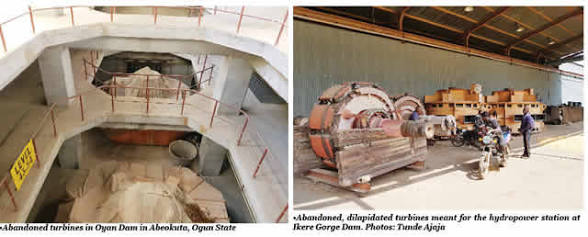
One of the most troubling examples of waste in Nigeria’s public sector remains the story of the multi-billion dollar hydropower turbines acquired during the administration of former President . The equipment, procured to strengthen Nigeria’s electricity generation capacity, was expected to play a vital role in addressing the country’s chronic power shortages. Instead, the turbines became a symbol of policy failure, bureaucratic negligence, and the absence of accountability in public administration.
After their acquisition, the turbines were reportedly left unused for years at storage facilities around the port areas of Waaf, Lagos State. Rather than being deployed to power stations where they could contribute to national electricity generation, the expensive machines were abandoned, exposed to weather conditions and gradually deteriorating. What should have been a strategic national asset capable of improving energy supply across Nigeria slowly turned into a monument of waste.
For years, the turbines remained idle while Nigeria’s electricity crisis deepened. Businesses continued to rely on generators, industries struggled with high production costs, and millions of households endured unstable power supply. Ironically, while the nation searched desperately for solutions to its energy problems, equipment worth billions of dollars sat unused and decaying in storage.
Eventually, the neglected turbines reportedly lost much of their value and were later disposed of as scrap, with buyers from said to have acquired the equipment at auction. The outcome represented a staggering loss of public resources and raised serious questions about the systems of planning, procurement, and project implementation in government.
The episode highlights a deeper structural problem in governance: the absence of continuity and accountability in national projects. Large-scale investments are often initiated with grand announcements but abandoned when administrations change or when bureaucratic bottlenecks arise. Without strong institutional oversight, such projects easily become casualties of political transitions and administrative inertia.
No responsible government can afford to watch strategic infrastructure investments worth billions of dollars deteriorate into scrap. Countries that have successfully transformed their energy sectors do so by protecting public investments, maintaining project continuity, and holding officials accountable for waste or negligence.
Nigeria’s persistent electricity crisis makes the abandoned turbine episode even more painful. At a time when the country urgently needed additional power generation capacity, resources that could have improved the national grid were left to rot.
The lesson is clear: until Nigeria builds stronger institutions, transparent procurement systems, and strict accountability for public projects, the cycle of waste will continue. Infrastructure meant to power the nation will remain stranded, while citizens continue to pay the price for failed governance.


