

Economic analysts are revisiting Nigeria’s growth trajectory over the past decade, drawing comparisons between the administrations of former President Goodluck Jonathan and President Bola Ahmed Tinubu amid renewed debate over the country’s economic direction.
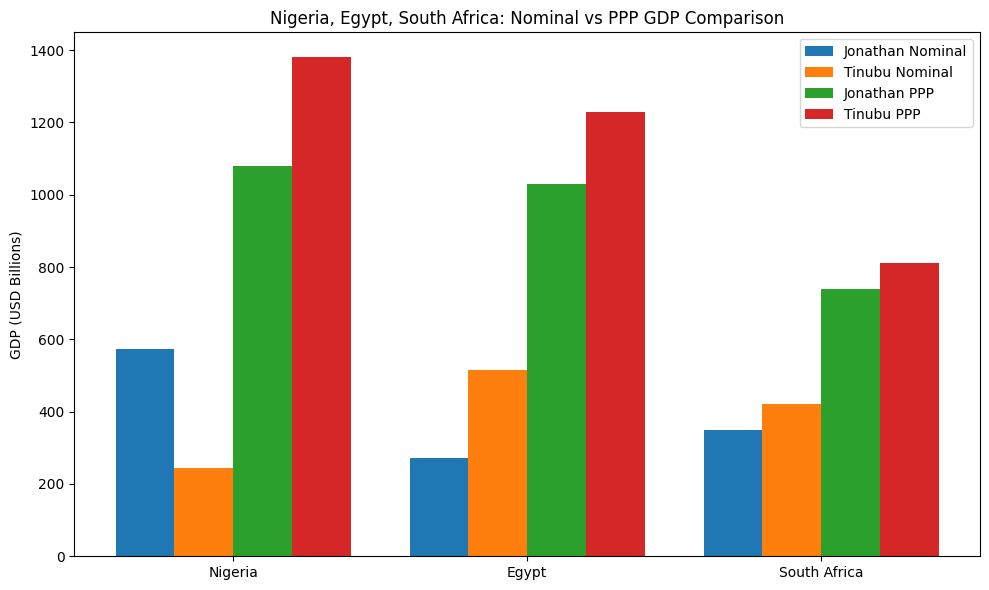
In 2014, during Jonathan’s administration, Nigeria rebased its Gross Domestic Product (GDP), emerging as Africa’s largest economy at the time. Following the rebasing exercise, Nigeria’s nominal GDP rose to approximately $574 billion, reflecting a significant expansion in the size of the economy in dollar terms. Analysts note that in addition to nominal growth, purchasing power parity (PPP) measurements also indicated steady domestic economic activity during that period.
Despite political criticism of Jonathan’s leadership at the time, economic data suggested improvements in output and overall macroeconomic performance, particularly prior to the 2016 recession that followed the oil price crash.
A decade later, Nigeria’s nominal GDP has declined significantly in dollar terms, currently estimated at about $244 billion. Economists attribute much of the contraction to currency depreciation, foreign exchange volatility, and broader macroeconomic adjustments. In contrast, Egypt’s nominal GDP is estimated at approximately $516 billion, while South Africa’s stands at around $420 billion, placing both countries ahead of Nigeria in dollar-denominated rankings.
However, analysts caution that nominal GDP figures alone do not provide a complete picture of economic performance. When adjusted for purchasing power parity, which accounts for domestic price levels and strips out exchange rate distortions, Nigeria’s GDP is estimated at roughly $1.38 trillion. This represents growth in real domestic output compared to a decade earlier.
Economists explain that the divergence between nominal and PPP-based measurements highlights structural challenges, particularly currency instability and reliance on oil exports. While domestic production and consumption may show resilience, exchange rate pressures can significantly affect Nigeria’s global economic standing, foreign investment appeal, and debt servicing capacity.
Policy experts argue that the contrast between nominal contraction and PPP growth underscores the need for structural reforms aimed at strengthening the naira, diversifying exports, improving fiscal discipline, and enhancing investor confidence.
They also note that political rhetoric often dominates public discourse, while deeper economic fundamentals receive less sustained attention. According to several analysts, sustainable progress will depend on long-term policy consistency, diversification away from oil dependence, improved productivity, and transparent economic governance.
As Nigeria navigates ongoing reforms and prepares for future electoral cycles, economists say the focus will remain on whether policymakers can convert domestic economic activity into stronger global competitiveness and improved living standards for citizens.
The broader debate continues to centre on how best to align political leadership, economic management, and structural reform to ensure long-term stability and inclusive growth.


