

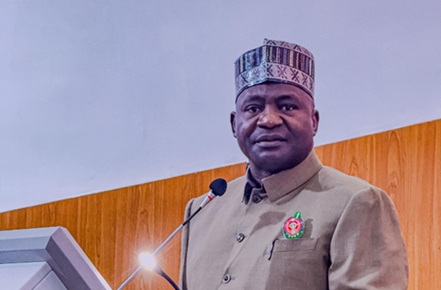
Nigeria’s Minister of Defence, General Christopher Gwabin Musa (retd.), has identified cyberattacks as one of the greatest threats to election security, warning that security challenges surrounding elections have evolved from physical threats to the digital space.
Musa made the remarks while highlighting emerging security concerns ahead of Nigeria’s 2027 general elections, stressing the need for authorities to strengthen the country’s cybersecurity capabilities as political activities intensify.
According to the minister, the nature of election-related threats has changed significantly with the increasing dependence on technology and digital platforms. While traditional security threats such as violence, intimidation and physical attacks remain concerns, cyber operations can now be deployed to disrupt electoral processes, spread disinformation and undermine public confidence.
Musa said security agencies must therefore broaden their approach to election protection by paying greater attention to activities taking place in cyberspace.
The minister’s warning comes at a time when Nigeria is increasingly relying on digital technology for electoral administration, communication and political mobilisation. From voter information systems and electronic transmission of results to social media platforms used by political parties and candidates, technology has become an integral part of the electoral process.
However, greater digital dependence also creates new vulnerabilities.
Cybercriminals and hostile actors could potentially target government websites, electoral databases and communication platforms, while coordinated disinformation campaigns could be used to create confusion before, during or after an election.
The spread of false information on social media has become a particularly important concern. Unverified claims about election results, voting procedures or alleged electoral irregularities can spread rapidly, potentially triggering tension among political supporters before authorities have an opportunity to establish the facts.
Musa’s warning therefore places cybersecurity alongside conventional election security as a major priority for the country’s security architecture.
He stressed the need for security agencies and other institutions involved in the electoral process to anticipate emerging threats rather than responding only after attacks have occurred.
The minister’s position also underscores the importance of cooperation between the military, police, intelligence agencies, electoral authorities and cybersecurity institutions.
Effective election security, he suggested, will require the sharing of intelligence and rapid responses to threats emerging across both physical and digital environments.
The warning comes as political parties prepare for the 2027 general elections, with campaigns expected to generate increased activity across social media and other digital platforms.
Political candidates and their supporters are already using online platforms extensively to communicate with voters, promote campaign messages and respond to political opponents. This growing digital political environment creates opportunities for legitimate political participation but also provides room for manipulation and malicious cyber activity.
Beyond attacks on electoral infrastructure, cyber threats could also target political parties, candidates, journalists and civil society organisations.
Compromised social media accounts, leaked or manipulated documents and fabricated audio or video could be used to falsely attribute statements to political actors and influence voters.
The emergence of artificial intelligence has further complicated the challenge, making it increasingly possible to produce convincing manipulated images, videos and audio recordings.
For Nigeria, the challenge ahead will therefore involve protecting not only physical polling locations but also the information environment surrounding the election.
Musa’s warning serves as a reminder that election security in the digital age extends beyond preventing violence at polling units.
As the country moves towards 2027, protecting the integrity of the electoral process will increasingly depend on the ability of Nigerian institutions to detect, prevent and respond to cyberattacks while ensuring that voters have access to accurate and credible information.
With cyber threats evolving rapidly, strengthening Nigeria’s digital defence capabilities could become one of the most important components of preparations for a secure and credible 2027 election.