
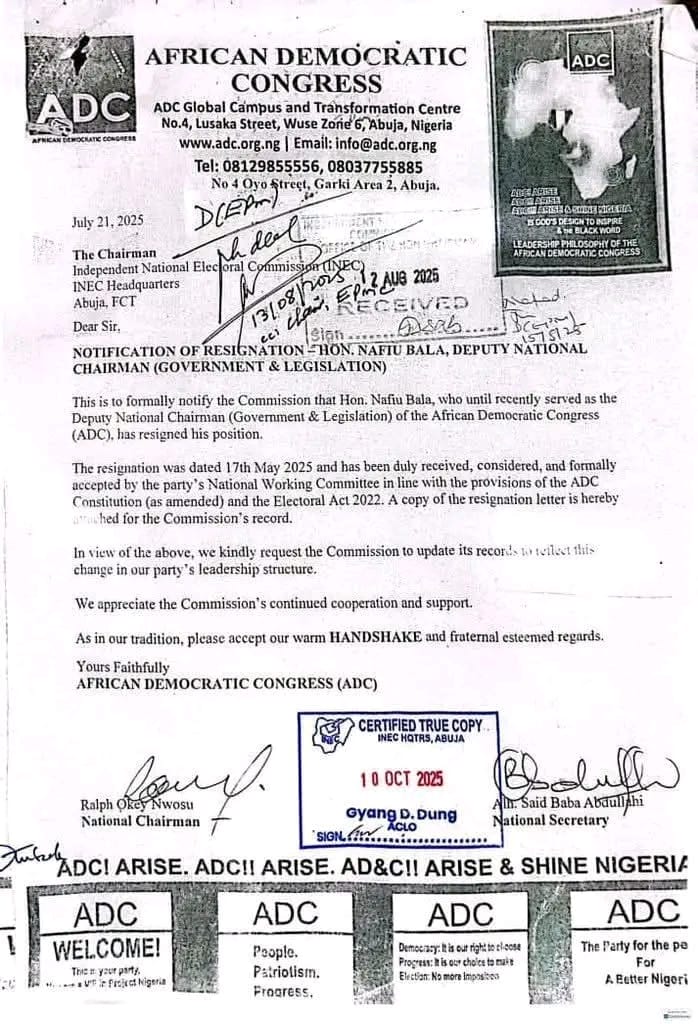
A fresh legal and political storm has intensified within the African Democratic Congress (ADC) following a court action initiated by former party chieftain, Nafiu Bala, who had earlier tendered his resignation from the party’s leadership and INEC acknowledged a copy of the resignation.
The development has triggered widespread concern and debate, with many questioning how an individual who voluntarily stepped down—and whose resignation was reportedly communicated to the Independent National Electoral Commission (INEC)—could return to court to assert leadership claims within the same political structure.
Adding a new layer to the controversy is the reported position of the Court of Appeal, which affirmed the maintenance of the status quo pending the resolution of the dispute at the Federal High Court. However, critics allege that despite this judicial position, INEC has taken actions perceived to have disrupted the smooth political operations of the ADC.
Some stakeholders within the party have gone further to accuse INEC of acting in a manner that appears to align with the interests of the ruling All Progressives Congress (APC) under President Bola Ahmed Tinubu—a claim that has heightened political tensions and raised questions about institutional neutrality.
While these allegations remain contested, legal analysts caution that court rulings—particularly those maintaining status quo—are often subject to interpretation, and actions taken by regulatory bodies may hinge on their reading of the legal and procedural context.
Within the ADC, however, frustration continues to mount. Party insiders insist that Bala’s resignation should ordinarily foreclose any subsequent claim to authority, describing the ongoing litigation as destabilizing. Others warn that the increasing recourse to courts in resolving internal party disputes risks undermining party cohesion and public trust.
Despite the growing backlash, it is important to note that the court’s intervention may not represent a final determination on the substantive issues, but rather an interim position pending full adjudication.
As events continue to unfold, attention is now firmly on INEC, the judiciary, and the ADC leadership to provide clarity and direction. The outcome of this dispute could carry significant implications—not just for the party, but for the broader political landscape ahead of the 2027 general elections.
The situation underscores once again the delicate balance between law, politics, and institutional responsibility in Nigeria’s democracy—where perception, process, and power remain deeply intertwined.
BREAKING: Controversy Trails Court Ruling as Resigned ADC Chieftain Challenges Party Leadership

- Advertisement -

