

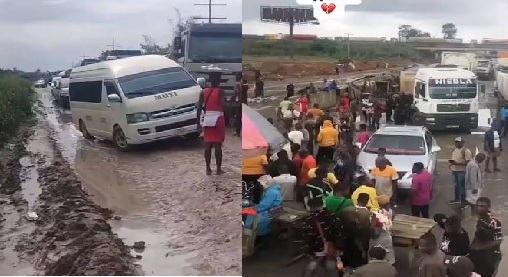
A worsening road crisis on the Benin-Agbor corridor in Edo State has left motorists and passengers stranded for days, with severe flooding, potholes and failed sections of the highway disrupting one of Nigeria’s important transportation routes.
The situation has triggered renewed anger among road users, who accuse authorities of failing to address the deteriorating condition of the highway despite years of complaints and significant public expenditure on maintenance.
Reports from the affected corridor indicate that trucks, buses and private vehicles have struggled to navigate flooded and badly damaged sections of the road. Some travellers have reportedly spent nights on the highway, while others abandoned their vehicles and trekked through difficult terrain in search of alternative routes.
The crisis has been particularly severe since heavy rainfall worsened already damaged portions of the Benin-Agbor Road. Videos circulating online showed long queues of vehicles trapped in the mud, with some motorists attempting to create makeshift routes through surrounding bush areas to escape the gridlock.
For passengers caught in the congestion, the consequences have extended beyond delayed journeys.
Some travellers reportedly complained of shortages of food and drinking water after remaining trapped for prolonged periods. Small traders operating along the route have also suffered losses, with perishable goods such as fish reportedly spoiling because vehicles could not move through the affected sections.
The situation has generated fresh criticism of Nigeria’s approach to road infrastructure, particularly the tendency to undertake major new projects while existing strategic highways continue to deteriorate.
The Federal Government has reportedly spent at least N1.46 billion between 2021 and 2026 on maintenance, repairs, rehabilitation and pavement-strengthening works on the deteriorating Benin-Agbor road. Yet the current crisis has raised questions about the effectiveness and sustainability of those interventions.
The controversy has also revived earlier warnings by Peter Obi about Nigeria’s infrastructure priorities.
In a resurfaced video and previous statements, the former Anambra State governor and 2027 presidential candidate argued that government should give greater attention to repairing existing roads that Nigerians already depend on rather than concentrating excessively on new infrastructure projects.
Obi has repeatedly identified major roads across Nigeria that require urgent intervention, arguing that functional transportation infrastructure is essential to economic productivity.
His argument has gained renewed attention as images of the Benin-Agbor corridor circulate online.
The road is strategically important because it connects communities in Edo and Delta states and forms part of the wider transport network linking the South-West with the South-South and South-East.
When such a corridor becomes impassable, the consequences extend beyond individual travellers. Businesses face higher logistics costs, agricultural products struggle to reach markets, and transportation operators incur additional expenses from delays, vehicle damage and fuel consumption.
Residents and motorists have consequently called for immediate intervention rather than waiting for the completion of broader reconstruction works.
The Benin-Asaba Expressway Concession Company, which is handling reconstruction of the wider highway, has said the project has not been abandoned and that work is progressing. The company has also acknowledged temporary flooding in some locations and said drainage improvements are being undertaken.
However, ongoing reconstruction has done little to ease the immediate hardship being experienced by road users on severely affected sections.
The frustration boiled over into protests in August, with residents and motorists demanding urgent repairs. Protesters said they did not want political handouts but wanted the government to make the road usable.
The crisis has also exposed the vulnerability of Nigeria’s road infrastructure to seasonal rainfall.
While heavy rainfall can complicate construction and maintenance, the scale of the disruption has raised questions about drainage design, preventive maintenance and the resilience of major highways.
For travellers, however, the issue is less about technical explanations and more about being able to move safely from one destination to another.
The Benin-Agbor crisis has therefore become another reminder of the economic cost of poor infrastructure.
As Nigeria approaches the 2027 general election, roads are likely to feature prominently in the political debate, with opposition figures expected to use deteriorating infrastructure as evidence of what they describe as misplaced government priorities.
The immediate demand from affected communities is simple: repair the road, restore movement and prevent another rainy season from turning a major national highway into a trap for thousands of Nigerians.