

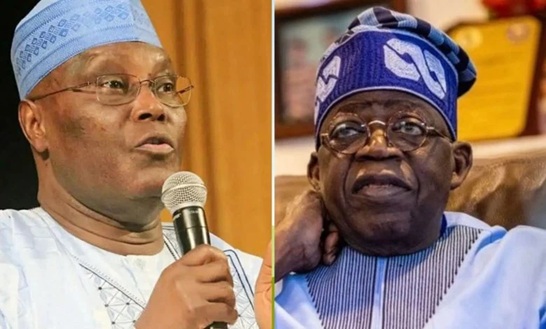
Former Vice-President and presidential candidate of the African Democratic Congress, Atiku Abubakar, has claimed that he possesses evidence showing that President Bola Ahmed Tinubu is 90 years old, declaring that he is prepared to present the evidence before a court.
Atiku made the claim in the latest escalation of the political battle surrounding the 2027 presidential election, as opposition figures continue to scrutinise the background and eligibility of President Tinubu.
The former Vice-President did not publicly disclose the evidence he referred to, but said the material would be presented through the appropriate legal process.
The claim represents another potentially contentious development in the increasingly heated political contest ahead of the 2027 general elections.
Questions surrounding the ages and personal records of Nigerian political leaders have repeatedly generated controversy, particularly during election periods. Atiku’s latest allegation is likely to intensify public debate over President Tinubu’s personal records and the documentation submitted in connection with his political career.
Atiku, who is seeking the presidency under the ADC platform, has increasingly positioned himself as one of the leading opposition figures challenging the Tinubu administration.
The former Vice-President has criticised several policies of the Federal Government while campaigning on an alternative political platform ahead of the 2027 election.
The latest claim, however, shifts attention from policy disagreements to the President’s personal records.
Under Nigeria’s electoral framework, presidential candidates must satisfy constitutional requirements concerning citizenship, age, education and other qualifications. Consequently, any credible dispute over a candidate’s eligibility could have significant legal and political implications.
President Tinubu’s age has been a subject of political controversy for years, although the President’s publicly stated date of birth is March 29, 1952, which would make him 74 years old in 2026.
Atiku’s assertion that Tinubu is 90 therefore represents a significant departure from the President’s publicly documented age.
The former Vice-President’s decision to say that he would present his evidence in court places the matter within the realm of legal scrutiny rather than simply political debate.
If such evidence is formally submitted, the court would have the responsibility of determining its authenticity, relevance and legal implications.
Until then, the claim remains an allegation and has not been established as fact.
The development is likely to attract considerable attention because disputes over candidates’ personal records can become politically charged in Nigeria.
Opposition parties have frequently accused political leaders of providing inconsistent information about their backgrounds, while supporters of those leaders have dismissed such claims as politically motivated attacks.
The latest controversy is occurring against the backdrop of preparations for the 2027 elections, with political parties already mobilising supporters and building campaign structures across the country.
The ADC has emerged as one of the platforms seeking to challenge the ruling All Progressives Congress, with Atiku at the centre of its presidential campaign.
The former Vice-President will therefore need to balance his campaign’s broader policy message with increasingly contentious political disputes surrounding the President.
For the Tinubu administration and its supporters, the allegation could provide another opportunity to challenge the credibility of Atiku’s campaign.
For Atiku and his allies, however, the promise to produce evidence in court indicates that they regard the matter as serious enough to warrant formal judicial examination.
The controversy also highlights the importance of reliable public records in a democratic system.
Questions concerning a political leader’s age, academic credentials or other personal details should ideally be resolved through authentic official documentation rather than competing political claims.
In an electoral environment where misinformation can spread rapidly, unverified allegations can easily become accepted as fact if not subjected to proper scrutiny.
The court, if the matter is formally brought before it, would therefore provide a more appropriate avenue for determining whether the evidence supports Atiku’s claim.
For now, the former Vice-President has offered a clear challenge: he says he has evidence and intends to produce it before the judiciary.
President Tinubu and his political camp are expected to respond to the allegation as the controversy gains momentum.
As the 2027 election draws closer, the dispute is another indication of how intensely contested the presidential race is becoming.
Ultimately, however, the question of President Tinubu’s actual age will have to be determined by credible documentary evidence and due process—not political assertions.
Until Atiku presents the evidence he says he possesses and the appropriate authorities examine it, the claim that President Tinubu is 90 years old remains an allegation, not an established fact.