

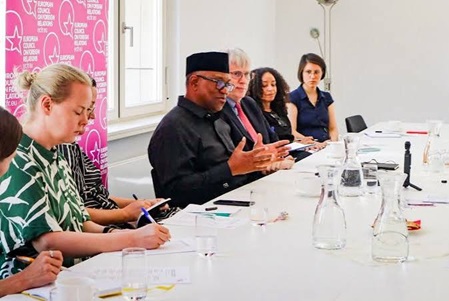
Nigeria Democratic Congress (NDC) presidential candidate, Peter Obi, has reiterated his claim that he won Nigeria’s 2023 presidential election, maintaining that the outcome announced by the Independent National Electoral Commission (INEC) did not reflect the true will of the electorate.
Obi made the remarks during a roundtable discussion hosted by the European Council on Foreign Relations (ECFR) in Berlin on July 15, where he addressed issues relating to democracy, governance and electoral integrity in Nigeria.
Speaking before an audience of policy experts, diplomats and international stakeholders, the former Anambra State governor asserted that the 2023 presidential election was marred by irregularities and insisted that available facts support his position that he emerged as the rightful winner of the contest.
According to Obi, many Nigerians remain convinced that the electoral process did not accurately reflect the votes cast. He argued that strengthening electoral institutions and ensuring transparency remain essential to deepening democracy and restoring public confidence in future elections.
The official results declared by the Independent National Electoral Commission, however, showed President Bola Ahmed Tinubu of the All Progressives Congress (APC) winning the election with 36.6 per cent of the votes cast, while Peter Obi, who contested under the Labour Party, secured 25.4 per cent to finish third behind former Vice President Atiku Abubakar.
Following the election, Obi challenged the outcome before the Presidential Election Petition Court, alleging widespread irregularities, non-compliance with electoral laws and failures in the transmission of election results. After the tribunal dismissed the petition, he proceeded to the Supreme Court, which in October 2023 affirmed Tinubu’s election and upheld the decisions of the lower court.
Despite the judicial rulings, Obi has consistently maintained that the election did not meet the standards of credibility expected in a democratic society. He has repeatedly called for comprehensive electoral reforms, including greater transparency in the use of technology, improved voter protection and stronger institutional accountability.
His latest comments have generated mixed reactions across Nigeria’s political landscape. Supporters argue that Obi’s remarks reflect the concerns expressed by many Nigerians over the conduct of the 2023 elections and reinforce the need for reforms that enhance electoral credibility.
Critics, however, contend that the election results have been conclusively settled through the constitutional legal process and argue that continued claims of victory risk undermining public confidence in democratic institutions. Some political commentators also point to the regional distribution of votes during the election as evidence that the official outcome reflected the electoral realities of the contest.
Political analysts note that disputes over election outcomes are not uncommon in Nigeria’s democracy, but stress that confidence in future elections will depend on implementing reforms that address concerns about transparency, technology and the administration of the electoral process.
With preparations for the 2027 general election gradually gathering momentum, Obi has continued to position electoral reform as a central element of his political agenda under the Nigeria Democratic Congress. Observers believe debates over the credibility of the 2023 election are likely to remain a recurring feature of Nigeria’s political discourse as parties prepare for another fiercely contested presidential race.
While opinions remain divided over Obi’s latest remarks, analysts agree that the discussion underscores the enduring importance of credible elections, strong democratic institutions and public trust in Nigeria’s constitutional processes.


