

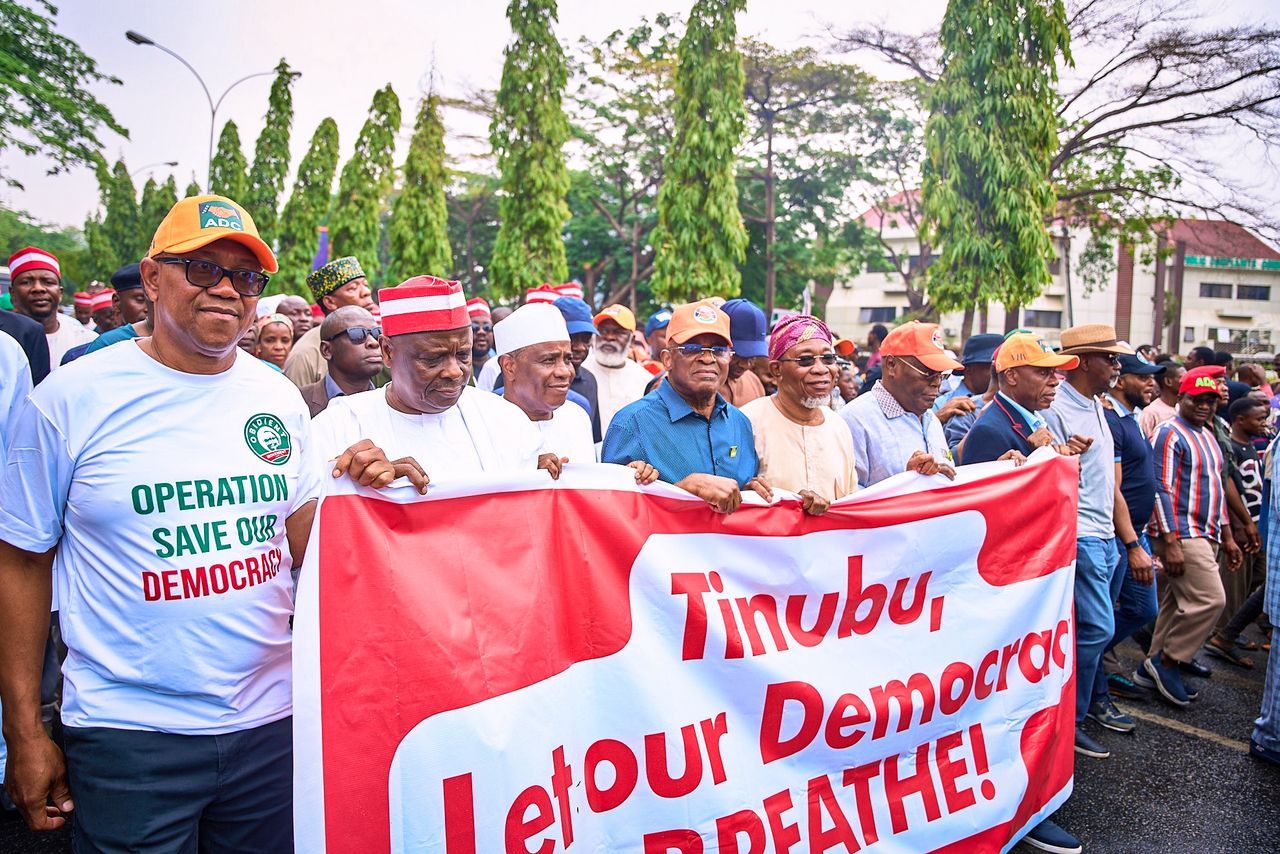
The recurring leadership crisis in the African Democratic Congress (ADC) serves as a stark reminder of a deep-seated problem in Nigerian politics: too many politicians treat rules as optional inconveniences rather than binding obligations. In recent weeks, the ADC has descended into chaos, with factions led by Senator David Mark, a rival group under Hon. Nafiu Bala Gombe, and a vocal bloc of state chairmen all laying claim to legitimacy while the Independent National Electoral Commission (INEC) has been forced to maintain a position of strict neutrality.
INEC removed the names of Senator David Mark and Ogbeni Rauf Aregbesola from its official portal on April 1, 2026, citing Court of Appeal preservatory orders. The Commission has since refused to recognise any faction or monitor any congresses or conventions until the substantive suit is resolved. Multiple suits are now pending before the Federal High Court in Abuja, with hearings and judgments scheduled for April 13 and 14, 2026. Meanwhile, the Mark-led faction has sued INEC seeking restoration of its status, and state chairmen have publicly rejected both major camps, announcing plans for their own interim structure.
This is not an isolated ADC problem. It reflects a broader culture in which politicians routinely bypass their own party constitutions, ignore mandatory statutory procedures, and rush to court at the slightest internal disagreement. The result is predictable: prolonged leadership vacuums, wasted resources, eroded public trust, and distraction from the real work of building viable parties ahead of the 2027 general elections.
The National Assembly anticipated exactly this abuse when it enacted the Electoral Act 2026. Section 83 is particularly instructive. It empowers INEC to monitor political parties and demand information or clarification where activities may breach the Constitution or any law. More importantly, it contains a clear ouster clause: subject to INEC’s monitoring role, no court in Nigeria shall entertain jurisdiction over any suit or matter pertaining to the internal affairs of a political party. Where such a prohibited suit is filed anyway, the court cannot grant interim or interlocutory injunctions. It must suspend any ruling and deliver judgment only at the final stage, with accelerated hearing. Crucially, the court is mandated to impose costs of not less than ₦10 million each on the lawyer who filed the action and on the plaintiff/applicant, plus additional costs to INEC where joined.
The Nigerian Bar Association (NBA), through President Mazi Afam Osigwe, SAN, was right to issue a firm statement on April 10, 2026, warning lawyers and judges against dragging the judiciary into intra-party disputes in violation of this provision. The NBA rightly described such actions as an abuse of court process and a violation of professional responsibility, pledging disciplinary steps before the Legal Practitioners Disciplinary Committee where necessary.
Yet the ADC crisis shows how slowly old habits die. The July 2025 process that produced the Mark-led caretaker committee was criticised for alleged breaches of the party’s 2022 Constitution (particularly the hierarchy in Articles 13 and 14, the narrow vacancy-filling rule in Article 17.4, and the absence of clear caretaker provisions). Instead of resolving these issues through proper internal mechanisms — such as mobilising two-thirds of non-resigned NEC members under Article 13 to summon a lawful meeting, followed by strict compliance with the 21-day notice requirement to INEC under Section 82 — the parties have turned the dispute into a courtroom spectacle.
This must stop. Nigerian politicians, across all parties, need to internalise a few basic truths:
First, *party constitutions are not suggestions.* They are the foundational rules that members voluntarily accepted. Ignoring provisions on how leadership vacancies are filled, how NEC meetings are summoned, or how caretaker structures (if any) may operate invites exactly the kind of chaos now playing out in the ADC.
Second, *the Electoral Act is not negotiable*. Section 82’s mandatory 21-day notice to INEC for any meeting involving the election or constitution of executive committees is clear. Failure to comply renders the exercise invalid. Section 83’s limitation on judicial interference is equally deliberate — it seeks to protect the electoral process from being hijacked by endless pre-election litigation.
Third, *due process is not weakness;* it is strength. Parties that resolve disputes internally through transparent, rule-based mechanisms build credibility with voters and with INEC. Those that resort to forum shopping, parallel structures, and premature court actions only demonstrate immaturity and erode public confidence in the entire democratic enterprise.
The ADC is not alone. Similar leadership tussles have afflicted the PDP, Labour Party, and others in recent years. Each time, the real losers are ordinary Nigerians who deserve functional political parties capable of offering credible alternatives rather than endless drama.
As the 2027 elections approach, the message is urgent: politicians must learn to obey the rules they themselves helped create. Party leaders should prioritise internal dialogue, constitutional compliance, and strict adherence to the Electoral Act. Lawyers should think twice before filing suits that clearly fall under the Section 83 bar. Courts should continue to exercise the restraint the law now demands. And INEC should remain the impartial referee it is constitutionally required to be.
Nigeria’s democracy will only mature when its politicians stop treating rules as obstacles to be circumvented and begin to see them as the guardrails that make genuine competition possible. The ADC crisis is a teachable moment. Let us hope our politicians are willing to learn.
The time for excuses is over. Due process or continued dysfunction — the choice is theirs, but the consequences belong to all of us.


