
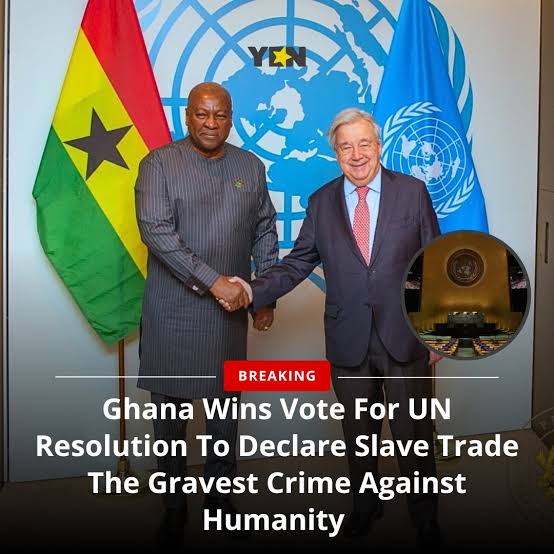
The recent decision by the United Nations General Assembly to declare the transatlantic slave trade as “the gravest crime against humanity” is, without doubt, historic. It is a long-overdue acknowledgment of one of the darkest chapters in human history—one whose consequences still shape global inequalities today.
Led by Ghana, the resolution reflects growing global pressure to confront the legacy of slavery, not just in words, but in action. Yet, while the symbolism is powerful, the substance remains incomplete. Recognition alone, no matter how emphatic, cannot substitute for justice.
The divide in the voting pattern tells its own story. While 123 nations supported the resolution, countries such as the United States, Israel, and Argentina opposed it. Meanwhile, the United Kingdom and several European Union states chose abstention—a diplomatic middle ground that avoids both responsibility and outright rejection.
For decades, former colonial powers have argued that present-day governments should not be held accountable for historical crimes. But this argument ignores a crucial reality: the economic and institutional advantages built on slavery did not vanish with abolition. They evolved, compounded, and continue to influence global wealth distribution, racial inequality, and development gaps.
If slavery is truly the “gravest crime against humanity,” as now affirmed, then the response must match the weight of that declaration. Crimes of such magnitude demand more than recognition—they demand repair.
Reparations need not be reduced to direct financial payouts alone. They can take many forms:
Strategic investments in education and infrastructure in affected regions
Debt relief for nations disproportionately impacted by colonial exploitation
Institutional reforms that address systemic inequalities
Cultural and historical restitution
What matters is not just the method, but the commitment to corrective justice.
This resolution should not be the end of the conversation—it should be the beginning of a more honest global reckoning. Without concrete steps toward reparations, the risk is that this historic declaration becomes yet another moral statement filed away in diplomatic archives.
The world has now agreed on the crime. The next question is unavoidable: Will it deliver justice?.
UN Declares Slave Trade Humanity’s Gravest Crime, Reparations Debate Ignites

- Advertisement -

