

Paris/Tehran/Washington — March 2026 —
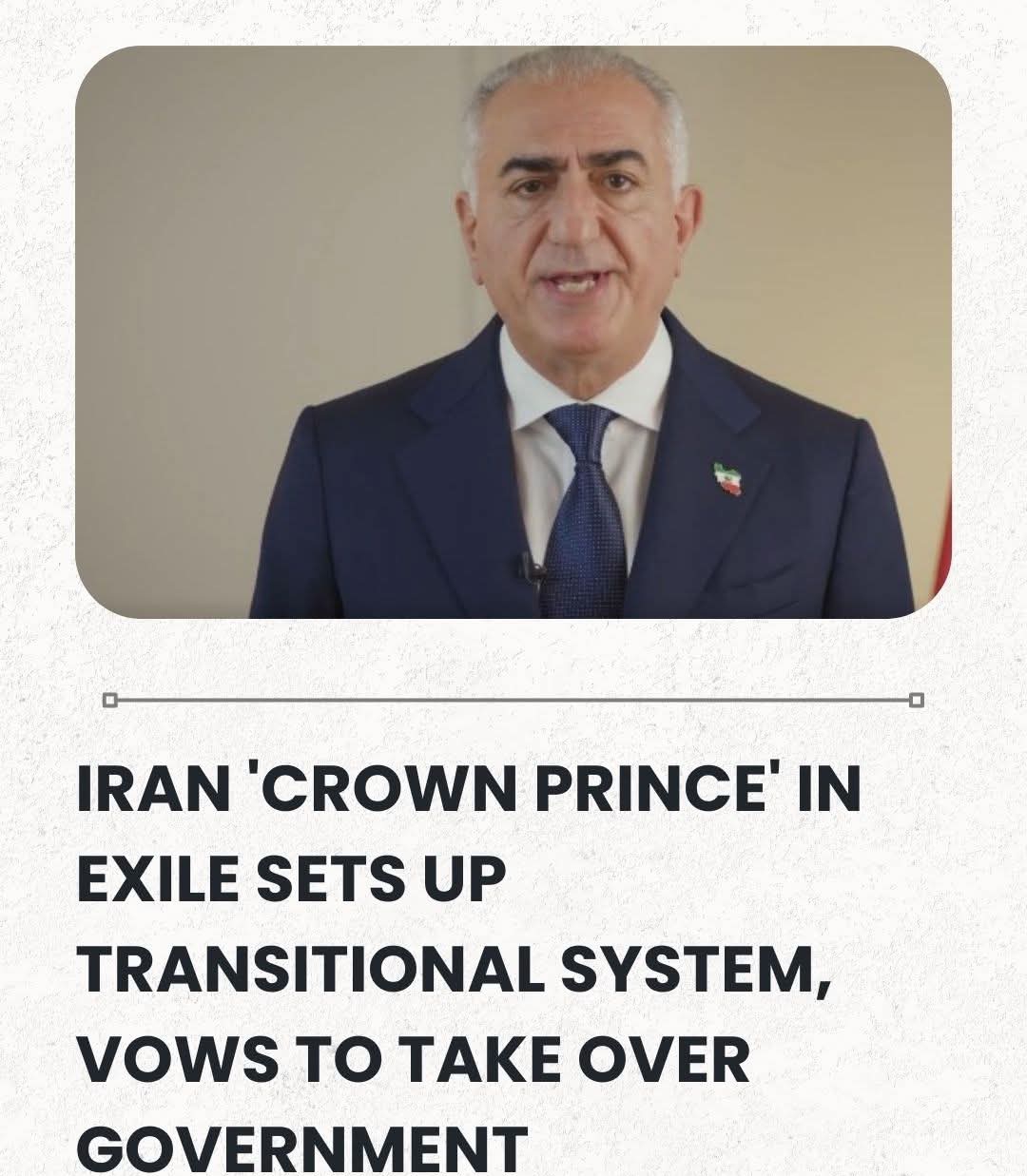
Amid ongoing unrest and conflict surrounding the Islamic Republic of Iran, exiled crown prince Reza Pahlavi has laid out a detailed plan for a transitional government he says is prepared to assume governance the moment the current regime collapses.
Pahlavi, who has long been a symbol of opposition to the clerical state, announced that a comprehensive transitional system has been developed under the framework of what opposition supporters call the Iran Prosperity Project, aimed at stabilizing the country and steering it toward democratic governance.
What the Transitional System Entails
According to plans circulated by the National Union for Democracy in Iran (NUFDI), the transitional structure Pahlavi champions would operate in phases, beginning with an “Emergency Phase” in the immediate aftermath of regime collapse. During this period, the system is designed to:
Establish governance continuity and prevent power vacuums
Retain existing laws and institutions as a legal default while dissolving those deemed incompatible with human rights and democratic transition
Create three central transitional bodies — a legislative branch (Transitional Mehestan), an executive transitional government, and a transitional judiciary — under Pahlavi’s leadership
Oversee stabilization, economic governance, social services, and institutional reform until democratic elections can be held.
The plan emphasizes legal stability and continuity while signaling a break from the Islamic Republic’s ideological framework. It proposes repealing laws that conflict with international human rights standards and Iran’s historical identity.
Origins and Opposition Support
Pahlavi’s transitional concept did not arise spontaneously. According to records of opposition coalitions and summit meetings, several Iranian liberal and nationalist groups met at the Munich Convergence Summit in 2025 to outline post‑regime governance and selected Pahlavi as the proposed leader of the transition.
Pahlavi has insisted repeatedly that he does not seek power for personal gain, emphasizing instead that his role would be to facilitate a stable transition and then hand over authority to a democratically elected government. He has also expressed his personal preference for a republic rather than a restored monarchy, leaving the ultimate decision to the Iranian people.
International and Domestic Challenges
Despite his detailed plan, Pahlavi faces significant challenges. His support inside Iran is difficult to verify, and some critics — including parts of the Iranian diaspora — question how broadly his vision resonates with ordinary Iranians. A portion of protests and opposition figures prefer a secular republic without a symbolic royal figure at the helm.
Internationally, major Western leaders have been cautious in publicly backing Pahlavi. In early 2026, the U.S. president declined to meet with him, signaling reluctance to commit to any single opposition figure while tensions in the region continue.
What Comes Next?
Pahlavi’s supporters argue that the transitional governance plan offers a credible blueprint for restructuring Iran after decades of clerical rule. They point to growing domestic protests and international pressure as signs that the current regime may be nearing a tipping point.
But detractors caution that political transition in a country as large and complex as Iran is unlikely to follow a simple script. Realizing a transitional government — even one with a well‑developed framework — will require broad internal consensus, defections within the security apparatus, and a political environment conducive to democratic institutions.
As Iran’s future hangs in the balance, Pahlavi’s proposal remains one of the most detailed and widely discussed post‑regime frameworks, blending legal continuity with ambitious institutional change. Whether it will ultimately shape the country’s path forward is a question that both supporters and critics are watching closely.


