

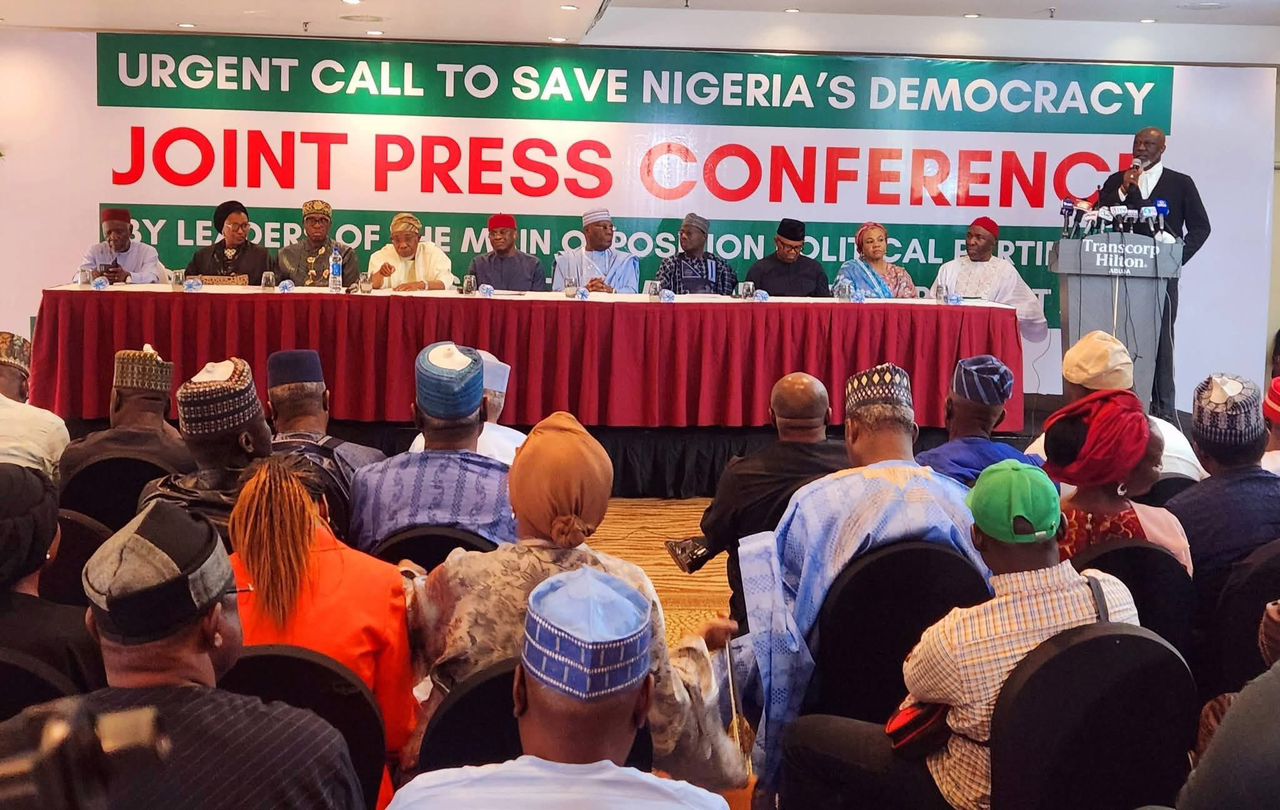
Opposition leaders of the African Democratic Congress (ADC) and the New Nigeria Peoples Party (NNPP) have jointly rejected the amended Electoral Act, describing the controversial provisions as a direct assault on Nigeria’s fragile democratic gains.
In a strongly worded position made available to the press, leaders of the African Democratic Congress and the New Nigeria Peoples Party warned that certain sections of the amended law threaten transparency, electoral credibility, and the independence of political parties.
Central to their objection is Section 60(3) of the amended Act, which they argue weakens the requirement for mandatory real-time electronic transmission of results to the IREV portal by allowing the Independent National Electoral Commission to revert to manual transmission under the claim of network failure. The opposition leaders insist that in a country with over 90 percent internet coverage, the justification of network challenges cannot serve as a blanket excuse to undermine electronic transmission, which they describe as one of the few safeguards against electoral manipulation.
They expressed concern that granting such discretionary powers to the Independent National Electoral Commission could reopen avenues for result alteration, particularly in remote collation centres where transparency is often weakest. According to them, real-time electronic transmission to the IREV portal was introduced to restore public trust after years of disputed elections, and any attempt to dilute that mechanism must be resisted by all well-meaning Nigerians.
The opposition leaders also rejected Section 84(2) of the amended law, which they say imposes either direct primaries or consensus candidacy on political parties. They argued that such a provision constitutes undue interference in the internal affairs of political parties and violates the principle of freedom of association guaranteed under the Constitution. Party leaders maintained that each political party should retain the autonomy to determine its mode of primary elections in line with its constitution and internal democratic processes.
Describing the amendments as regressive, the ADC and NNPP leaders called on civil society organizations, labour unions, student bodies, faith-based groups, and the international community to scrutinize the bill and demand revisions that strengthen — rather than weaken — Nigeria’s electoral framework.
The opposition parties further called on civil society groups and Nigerians across political, ethnic, and religious divides to reject what they described as a fraudulent electoral law designed to institutionalize opacity and undermine the sanctity of the ballot. They warned that democracy cannot survive where electoral rules are deliberately weakened to favour manipulation, insisting that any law that compromises transparency is a direct threat to the sovereignty of the people.
They urged Nigerians to remain vigilant and to collectively resist any legislative action capable of reversing the modest electoral reforms achieved in recent years, warning that democracy thrives only where electoral integrity is protected without compromise.


