

The United States and China have agreed to establish a communication channel for artificial intelligence-related incidents as the two countries seek to manage emerging risks from increasingly advanced AI systems.
The agreement forms part of broader discussions between Washington and Beijing aimed at creating mechanisms for communication on artificial intelligence, even as both countries continue to compete over advanced technology.
US Treasury Secretary Scott Bessent said earlier that American and Chinese officials had agreed to establish a formal AI dialogue, including an “incident line” through which the two countries could communicate about serious AI safety incidents. The discussions involved Bessent and Chinese Vice Premier He Lifeng.
The proposed mechanism is expected to provide a way for the two countries to alert each other about significant AI-related threats, particularly incidents with possible national security implications.
Bessent said the discussions would also focus on developing protocols for identifying major AI dangers, including potentially uncontrollable AI agents and threats involving non-state actors and cyber operations.
The initiative comes amid rapid advances in artificial intelligence and growing concern among governments about how increasingly capable systems could be misused or behave in unexpected ways.
The United States and China are currently the two leading competitors in the development of advanced AI technologies. Their rivalry extends beyond AI to trade, semiconductors, critical minerals, industrial policy and other strategic technologies.
Despite those tensions, officials from both countries have identified AI safety as an area where communication could help reduce the risk of misunderstandings or uncontrolled incidents.
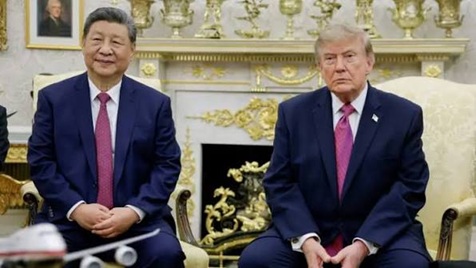
The planned communication channel was discussed during preparatory talks ahead of a meeting between US President Donald Trump and Chinese President Xi Jinping. The two leaders have also been discussing broader economic and technological issues affecting relations between Washington and Beijing.
PUNCH reported that the arrangement is part of efforts to create greater communication between the two countries over AI threats. Earlier discussions between Bessent and Chinese officials had already produced an agreement to continue formal AI dialogue.
The two sides are expected to hold another high-level meeting in Shenzhen, China, within about two months to continue discussions on AI safety and emergency communication protocols.
The proposed channel could be particularly relevant in cases where an AI incident has implications beyond the country where it originates. Such incidents could include major cybersecurity attacks, misuse of AI by non-state actors or the unexpected behaviour of highly autonomous systems.
However, the exact structure and scope of the communication mechanism have yet to be fully established. Analysts have noted that one challenge would be determining what constitutes an incident serious enough to trigger communication between the two governments.
The development comes as international leaders increasingly call for greater cooperation on AI safety. United Nations Secretary-General António Guterres recently urged countries with the greatest AI capabilities to establish channels for dialogue, transparency, trust and cooperation. He compared the need for communication over AI risks with the engagement between strategic rivals during the Cold War.
The US-China initiative does not mean the two countries have resolved their wider disagreements over artificial intelligence. Analysts have noted that Washington and Beijing remain engaged in intense technological competition, and the new mechanism is primarily a practical avenue for managing specific risks rather than a comprehensive agreement on AI regulation.
Nevertheless, the proposed communication channel represents a new area of direct engagement between the world’s two major AI powers at a time when governments are grappling with how to manage the security implications of increasingly powerful artificial intelligence systems.


