

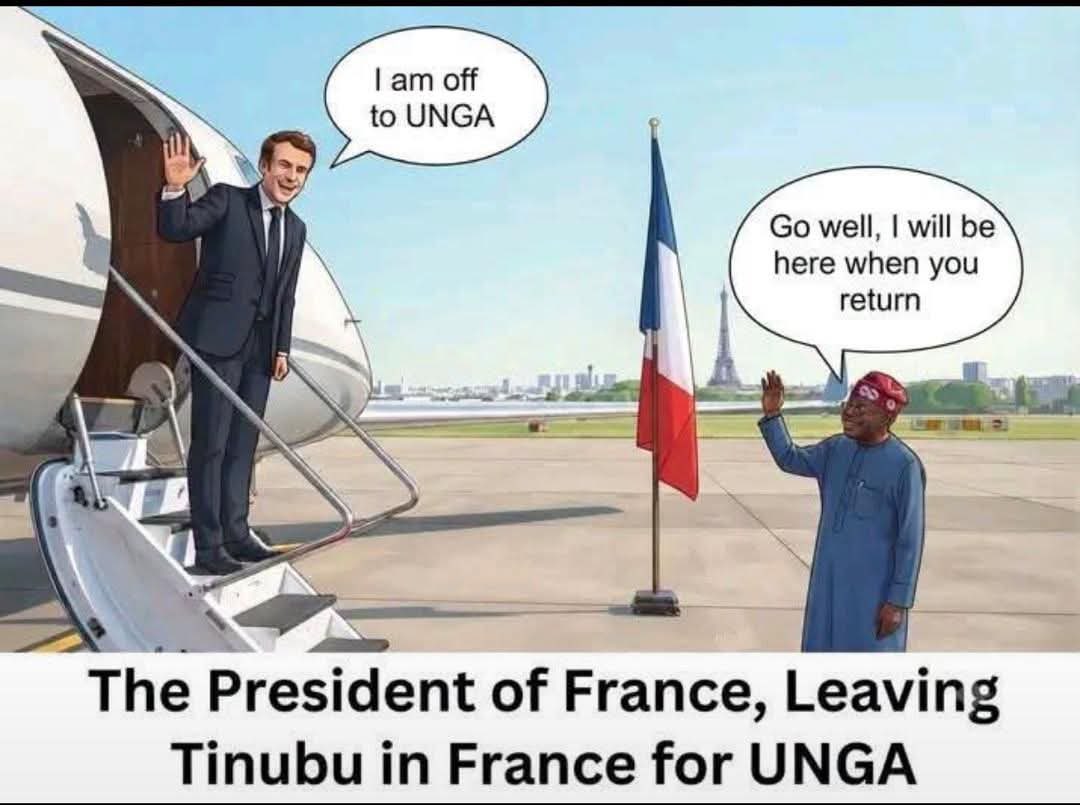
President Bola Ahmed Tinubu’s extended stay in France has triggered renewed debate over the constitutional procedure for transferring presidential functions to Vice-President Kashim Shettima when the President is away from Nigeria.
Tinubu left Nigeria on August 30, 2026, for what the Presidency described as a working vacation, travelling first to London before proceeding to Paris. On September 21, the State House announced that the President had extended his stay by a few days and was expected back in Nigeria at the weekend.
The development has attracted particular attention because the President’s absence has now gone beyond 21 days, the period specifically addressed by Section 145 of Nigeria’s 1999 Constitution.
Section 145 provides that whenever the President proceeds on vacation or is otherwise unable to discharge the functions of his office, he is to transmit a written declaration to the Senate President and the Speaker of the House of Representatives. If he fails or is unable to transmit such a declaration within 21 days, the National Assembly is required, by simple-majority resolutions of both chambers, to mandate the Vice-President to perform the functions of President as Acting President.
The controversy, however, is not simply whether Tinubu has been abroad for more than 21 days. The critical constitutional question is whether the required written declaration was transmitted to the leadership of the National Assembly and, if it was not, whether the National Assembly has taken the action contemplated by Section 145(2).
As of September 23, some lawmakers under the Save Democracy Group were publicly demanding that the leadership of the National Assembly disclose whether such a letter was transmitted. They argued that, if no declaration was received within the constitutionally prescribed period, both chambers should reconvene and consider mandating Shettima to act as President.
The Presidency, however, maintains that there is no leadership vacuum. It says Tinubu has continued directing the affairs of government from abroad and that the President has remained in contact with officials at home. The State House also said that Shettima had been delegated to represent Tinubu at some official functions.
Adding another layer to the situation, Shettima himself travelled to New York on September 20 to represent Nigeria at the 81st United Nations General Assembly. This has meant that, for a period, both the President and Vice-President have been outside Nigeria.
Senate President Godswill Akpabio has rejected suggestions that the President has vacated office or that there is a leadership vacuum. According to Akpabio, Tinubu remains in charge and his absence abroad does not mean that presidential authority has become vacant.
The controversy therefore goes beyond the President’s choice of France as a destination. It raises questions about constitutional transparency, continuity of executive authority and the formal chain of command during an extended presidential absence.
Critics have also questioned the frequency and duration of Tinubu’s foreign trips. A May 2026 analysis by The PUNCH calculated that Tinubu had spent approximately 261 days abroad since assuming office in May 2023, with France accounting for more than 50 days across multiple visits. The Presidency has defended the foreign engagements as part of diplomacy, investment promotion and international relations.
Against this backdrop, questions are being raised over why the President has chosen to remain abroad for an extended period while Nigeria faces pressing domestic challenges.
One of the political questions now being asked is whether the prolonged absence reflects a deliberate preference for governing remotely or concerns about formally transferring presidential functions to Shettima. That interpretation, however, remains speculative unless the President or the Presidency provides evidence explaining the decision.
The more immediate constitutional question is therefore straightforward: Did President Tinubu transmit the written declaration required under Section 145, and if he did not, why has the National Assembly not publicly addressed the 21-day provision?
Until that question is answered officially, the debate over who should formally exercise presidential functions during the extended absence is likely to continue.


