

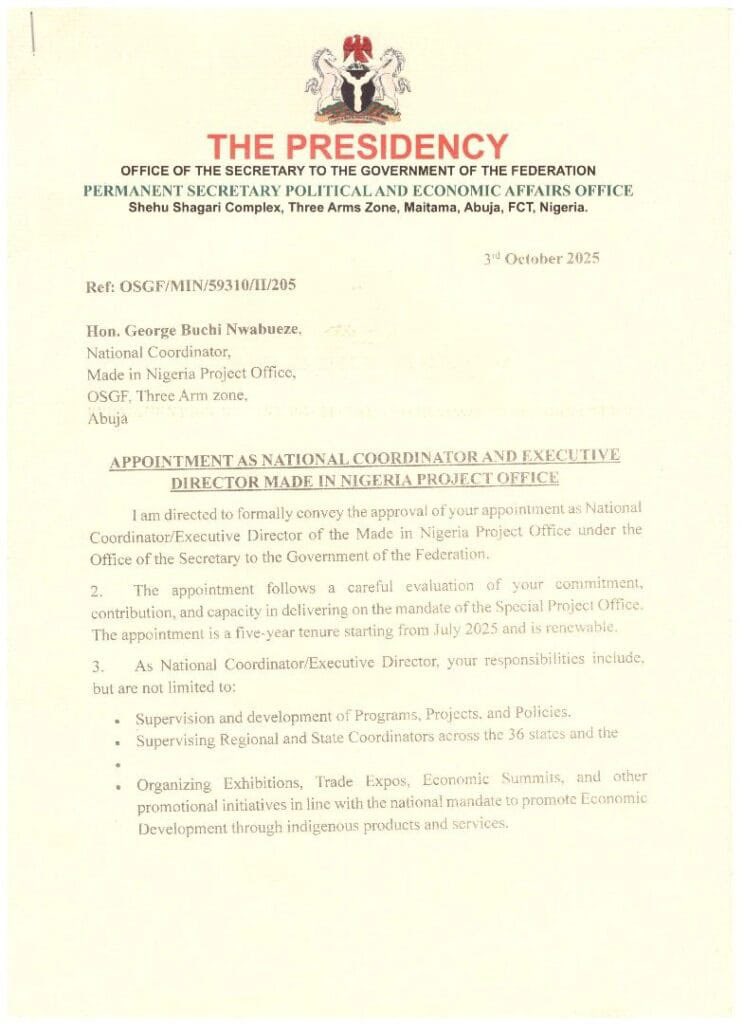
The controversy surrounding the alleged operation of a “fake” government agency inside Nigeria’s Office of the Secretary to the Government of the Federation (OSGF) has taken a fresh twist, after the man at the centre of the storm, George Buchi Nwabueze, produced an appointment letter bearing the OSGF letterhead and indicated that he is prepared to defend his position in court.
The document, dated October 3, 2025, and referenced OSGF/MIN/59310/11/205, purports to convey Nwabueze’s appointment as National Coordinator/Executive Director of the Made in Nigeria Project Office.
The letter, which is visible in the document released by Nwabueze, identifies the Permanent Secretary, Political and Economic Affairs Office, Nadungu Gagare, as the signatory. It states that the appointment was for a renewable five-year tenure beginning from July 2025.
According to the document, Nwabueze was responsible for supervising programmes, projects and policies; coordinating regional and state coordinators across the 36 states; and organising exhibitions, trade expos and economic summits to promote Nigerian-made products.
The letter further states that the project office would temporarily operate from Room B53, Ground Floor, within the OSGF complex.
ICPC says otherwise
The document has emerged after the Independent Corrupt Practices and Other Related Offences Commission (ICPC) alleged that the National Brands Development and Made in Nigeria Special Project Office was an unauthorised operation within the OSGF.
The commission said President Bola Ahmed Tinubu ordered Nwabueze’s arrest and the suspension of three Permanent Secretaries following its findings.
The ICPC also alleged that suspected collaborators within the OSGF helped facilitate the operation.
But Nwabueze has strongly rejected the allegation, insisting that the initiative was a special project rather than a statutory federal agency, and that it had operated within government structures for years.
Now, the courtroom enters the story
Nwabueze has also disclosed that he instituted Suit No. CV/2634/26 before the High Court of the Federal Capital Territory, Abuja, challenging what he described as attempts to remove the project from the OSGF structure and interfere with its official records.
According to his representatives, the court issued a writ on June 10, 2026, with an order directing parties to maintain the status quo pending determination of the substantive case.
The existence and scope of that court process should now be independently examined by the relevant authorities.
The bigger question: who authorised what?
The appointment letter does not, by itself, conclusively establish that the organisation was legally constituted as a federal agency. Indeed, Premium Times reported that it could not independently authenticate the document.
However, its emergence raises an equally serious question:
If the letter is genuine, who within government authorised the appointment, allocated office space inside the OSGF and permitted the project to operate under official government structures?
That question becomes even more important because reports indicate that other OSGF correspondence connected Nwabueze and the project with government activities. One recently reported June 2026 letter allegedly introduced him as National Coordinator/Chief Executive of the Made in Nigeria Product project for an international assignment involving preparations for the China-Africa Summit.
This creates two issues that must not be confused: whether the project was legally established as a government agency, and whether government officials formally recognised or facilitated its activities.
Tinubu, Gbajabiamila and the Presidency face uncomfortable questions
The unfolding scandal inevitably raises broader questions for the Presidency.
If the ICPC is correct that the organisation was fictitious or unauthorised, how did an entity described as operating from the OSGF obtain government-looking documentation, office space and apparent access to public officials?
And if Nwabueze is correct that he was officially appointed, who approved the appointment and under what legal authority?
Those questions cannot responsibly be answered by simply branding one side a fraudster or the other side corrupt.
The President, the Secretary to the Government of the Federation and the relevant supervisory authorities must establish the documentary chain—from creation, approval, appointment, office allocation and funding to official correspondence.
The recent discovery of multiple alleged fictitious government entities has already exposed serious weaknesses in Nigeria’s public-service verification and oversight systems. The ICPC has recommended disciplinary action against 13 officials in the wider fake-agency scandal, while investigations continue.
The real scandal may be bigger than one man
The Nwabueze affair should therefore not end with the arrest—or defence—of one individual.
If fake agencies can allegedly operate from federal government premises, obtain official-looking correspondence and interact with senior public officials without being detected, then the fundamental issue is institutional failure.
The Presidency must answer Nigerians:
Who knew? Who approved? Who signed? Who allocated the office? Who monitored the activities? Who authorised the correspondence? And, most importantly, was public money involved?
Until those questions are answered through a transparent investigation, the public will remain entitled to ask whether the alleged “fake agency” scandal is merely the work of rogue individuals—or evidence of a much deeper breakdown in the machinery of government.
**And that is where the investigation should now go.**


