

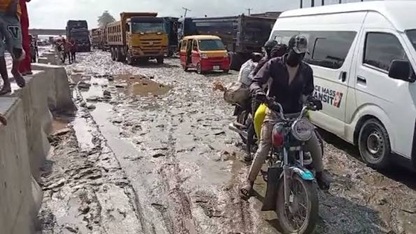
The Presidency has blamed the contractor handling the Benin-Agbor-Asaba road reconstruction for the highway’s worsening condition, as the Federal Government moves to address the crisis that has left motorists and travellers stranded for days.
The development followed growing public outrage over the deteriorating condition of the strategic highway linking Edo and Delta states, where heavy traffic, failed sections and flooding have caused prolonged delays and significant losses for commuters, transporters and businesses.
The Benin-Agbor-Asaba corridor was concessioned to the Benin-Asaba Expressway Concession Company (BAECC) in 2025 for reconstruction and expansion from four lanes to 10 lanes. The project was expected to be completed in September 2027, after which the concessionaire would operate and maintain the highway for 25 years.
However, the road has deteriorated badly in recent weeks, with motorists reportedly spending several days attempting to complete journeys that would normally take only a few hours.
During an inspection of the highway, Minister of Works David Umahi expressed deep dissatisfaction with the performance of the concessionaire and apologised to road users.
Umahi said the existing asphalt should not have been removed in the manner it was, arguing that the action contributed to the worsening condition of the highway. He accused the concessionaire of poor handling of the project and said the company had failed to meet the required technical standards.
The minister also disclosed that President Bola Tinubu had directed the redesign and total reconstruction of major roads around Edo State and adjoining corridors, with concrete pavement being considered for some of the projects.
According to Umahi, the Federal Government would not rely solely on temporary palliative measures because the scale of the problem required a more permanent solution.
The crisis has nevertheless exposed a dispute over responsibility.
While the government has placed much of the blame on the concessionaire, BAECC has defended its work, attributing some of the delays and difficulties to heavy rainfall and the enormous volume of traffic using the highway.
The company’s Chief Executive Officer, Samuel Daramola, said construction teams had already expanded sections of the road and undertaken palliative work but faced difficulties completing drainage infrastructure while keeping the heavily congested highway open to traffic.
The project consultant also reportedly said the concessionaire had ignored advice to prioritise drainage works, contributing to problems along the corridor.
The consequences have been severe for travellers.
Motorists have reported spending days trapped around Agbor, with some passengers forced to sleep inside vehicles because they could not afford hotel accommodation. Truck drivers have also complained that the delays are affecting the transportation of goods and increasing the risk of perishable products being damaged.
One driver reportedly said a journey from Lagos to Asaba that would ordinarily take hours took three days because of the road conditions.
Businesses along the corridor have equally complained about the economic impact, as poor road access disrupts the movement of people, agricultural products and other goods.
The Federal Government has now indicated that it will review concession agreements for roads where contractors fail to meet their obligations.
Chairman of the House Committee on Works, Akin Alabi, also called for a review of concession agreements, arguing that Nigerians expect roads to remain usable while reconstruction is taking place.
The latest development comes amid a broader national debate over Nigeria’s deteriorating federal highways. Several other major routes across the country have also been criticised for poor conditions, highlighting the enormous infrastructure challenge confronting the government.
For residents and motorists, however, the immediate priority is not the argument over who is responsible. It is restoring movement.
The Benin-Agbor-Asaba highway is an important economic corridor connecting the South-South with the South-East and other parts of Nigeria. Continued disruption therefore has consequences far beyond Edo and Delta states.
The Presidency’s decision to intervene could provide relief if the promised reconstruction and palliative measures are implemented quickly.
But the controversy also raises a larger question about Nigeria’s road concession system: if private concessionaires are entrusted with critical national infrastructure, how effectively is government monitoring their performance and protecting the public interest?
For thousands of stranded travellers and businesses already counting their losses, the answer cannot come through another promise alone.
They need a road that works.


