

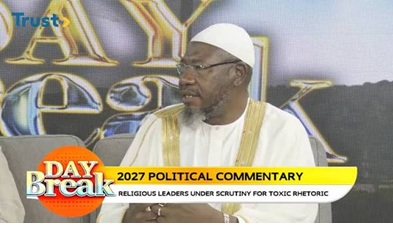
Islamic leaders have cautioned Muslim clerics and political actors against inflammatory statements targeting Christians as controversy continues to surround President Bola Tinubu and Vice President Kashim Shettima’s Muslim-Muslim ticket ahead of the 2027 presidential election.
The warning comes amid renewed debate over the decision by the All Progressives Congress to retain the same-faith presidential ticket for the 2027 election. The issue has generated strong reactions across Nigeria, with concerns that religious rhetoric could deepen existing divisions in the country.
Speaking against the backdrop of the controversy, Islamic leaders urged Nigerians to focus on competence, fairness, justice, national development and unity rather than allowing religion to determine political choices.
The debate intensified following comments attributed to Kaduna-based Islamic cleric, Sheikh Sani Yahaya Jingir, who linked the success of the Muslim-Muslim ticket to the numerical strength of Muslims in Nigeria. His remarks sparked criticism, with opponents warning that such statements could heighten religious tension in an already divided political environment.
However, some Muslim leaders have sought to distance the broader Islamic community from provocative rhetoric. They argued that political support for a same-faith ticket should not be interpreted as hostility towards Christians or as an endorsement of religious domination.
One of the voices urging restraint is Sheikh Daood Molaasan, founder and National President of Jama’atu Ta’awunil Muslimeen. He specifically cautioned Muslim leaders against making statements that could offend Christians or followers of other faiths.
Molaasan stressed that Islam teaches unity and respect, warning that offensive comments could ultimately damage the government and political interests that supporters of the Muslim-Muslim ticket are seeking to advance.
Another Islamic leader, Ahmad, argued that Nigerians should examine the performance of government rather than reducing every political issue to religion. He questioned whether Muslims had necessarily benefited from the same-faith ticket simply because both the President and Vice President are Muslims.
He also pointed to the concerns recently raised by Catholic bishops, noting that their discussions with the President focused largely on economic hardship and other national challenges rather than the religious composition of the presidential ticket.
The controversy has nevertheless continued to attract political reactions. Former Aviation Minister Femi Fani-Kayode described some of Jingir’s comments as provocative and warned against rhetoric that could create further religious tension. He maintained that Nigeria is a secular, multi-religious country whose diversity should be regarded as a strength rather than a source of political division.
The issue has also drawn criticism from political figures outside the ruling party. Nigeria Democratic Congress vice-presidential candidate Rabiu Kwankwaso recently called on the Federal Government to caution Jingir over remarks he considered anti-Christian.
The renewed religious debate comes at a sensitive period as political parties and aspirants prepare for the 2027 elections. Religion has historically played an important role in Nigerian electoral politics, particularly in debates surrounding presidential tickets and regional representation.
The latest development has also coincided with efforts by Muslim and Christian leaders to promote religious harmony. More than 50 Nigerian Muslim and Christian leaders recently signed a peace accord in Abuja aimed at strengthening interfaith cooperation and curbing extremism and hate speech.
With the 2027 election approaching, Islamic leaders are now urging political and religious actors to exercise restraint and avoid language that could turn political competition into religious confrontation.
They maintained that Nigerians should judge political leaders by their competence, integrity, fairness, performance and commitment to national development, rather than allowing religious identity to become the primary basis for political mobilisation.
The warning underscores the growing concern that careless political rhetoric could deepen religious mistrust at a time when national unity remains one of Nigeria’s most pressing challenges.


