

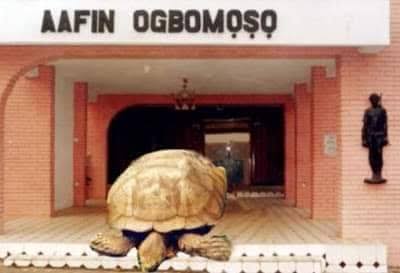
A tortoise believed to be about 420 years old and popularly known as Baba has died at the palace of the Alaafin of Oyo in Oyo State, bringing to an end the life of an animal that had become closely associated with the history and traditions of the ancient Oyo Kingdom.
Baba reportedly died on Monday after falling ill and losing its appetite. The animal was subsequently buried, according to the Director of Media and Publicity to the Alaafin, Bode Durojaiye, who confirmed the development in a statement issued in Ibadan on Thursday.
The palace described Baba as far more than an ordinary palace pet, saying the tortoise had become an important part of the oral history of the Yoruba people. According to Durojaiye, successive Alaafins had cared for Baba, inheriting the animal as part of the historical relics associated with previous monarchs.
“Baba was more than a turtle in status. He represented a part of the oral history of the Yoruba race,” Durojaiye said, adding that the Alaafin had lost an “ageless companion.”
According to the palace, oral history traced Baba’s origin to Oyo-Ile, the ancient capital of the old Oyo Empire. The tortoise was reportedly brought from Oyo-Ile to the present-day palace in Oyo town, where it remained under the care of palace officials for generations.
Its reported age and unusual size turned Baba into a tourist attraction. Visitors to the Alaafin’s palace reportedly made special trips to see the tortoise, which had become one of the unusual historical features associated with the ancient royal institution.
Two palace officials were reportedly assigned responsibility for caring for Baba. Its diet included watermelon, corn pap wrapped in leaves and grass. The palace said the animal remained strong and friendly and attracted visitors because of its extraordinary longevity.
Baba’s significance extended beyond its physical presence at the palace. According to the palace, the animal was regarded in Oyo as the oldest indigene and had survived successive generations of rulers.
The tortoise was reportedly already at the palace when the incumbent Alaafin, Oba Abimbola Akeem Owoade I, assumed the throne. Durojaiye said the monarch inherited Baba as part of the historical relics associated with the palace.
The animal’s death has also drawn attention to Yoruba cultural ideas surrounding continuity between generations and the relationship between the living, the dead and those yet unborn. Durojaiye referenced Nobel Laureate Wole Soyinka’s acclaimed play, Death and the King’s Horseman, in discussing the cultural significance attached to the history of the Oyo monarchy.
Unlike the characters and traditions explored in Soyinka’s work, Baba’s role in the palace was that of a living witness to generations of royal history. Its survival across successive reigns made it, in the palace’s oral tradition, a symbolic link between Oyo’s past and present.
The palace said Baba fell ill on Monday and stopped eating before eventually dying. Its remains have since been buried.
The reported age of 420 years, however, is based on palace oral history and has not been independently established through scientific dating. A previous case involving another ancient Oyo State palace tortoise illustrates the difficulty of independently verifying such claims. In 2019, a tortoise known as Alagba at the palace of the Soun of Ogbomoso was reported to have lived for 344 years, with officials explaining that its age was estimated from historical records concerning its arrival at the palace.
For the Alaafin’s palace, Baba’s death represents the loss of a creature that had become inseparable from the institution’s cultural identity and a familiar attraction for visitors.
The palace has indicated that efforts will be made to preserve Baba’s memory for future generations, ensuring that the story of the extraordinary tortoise remains part of the historical narrative surrounding the ancient Oyo Kingdom.


