
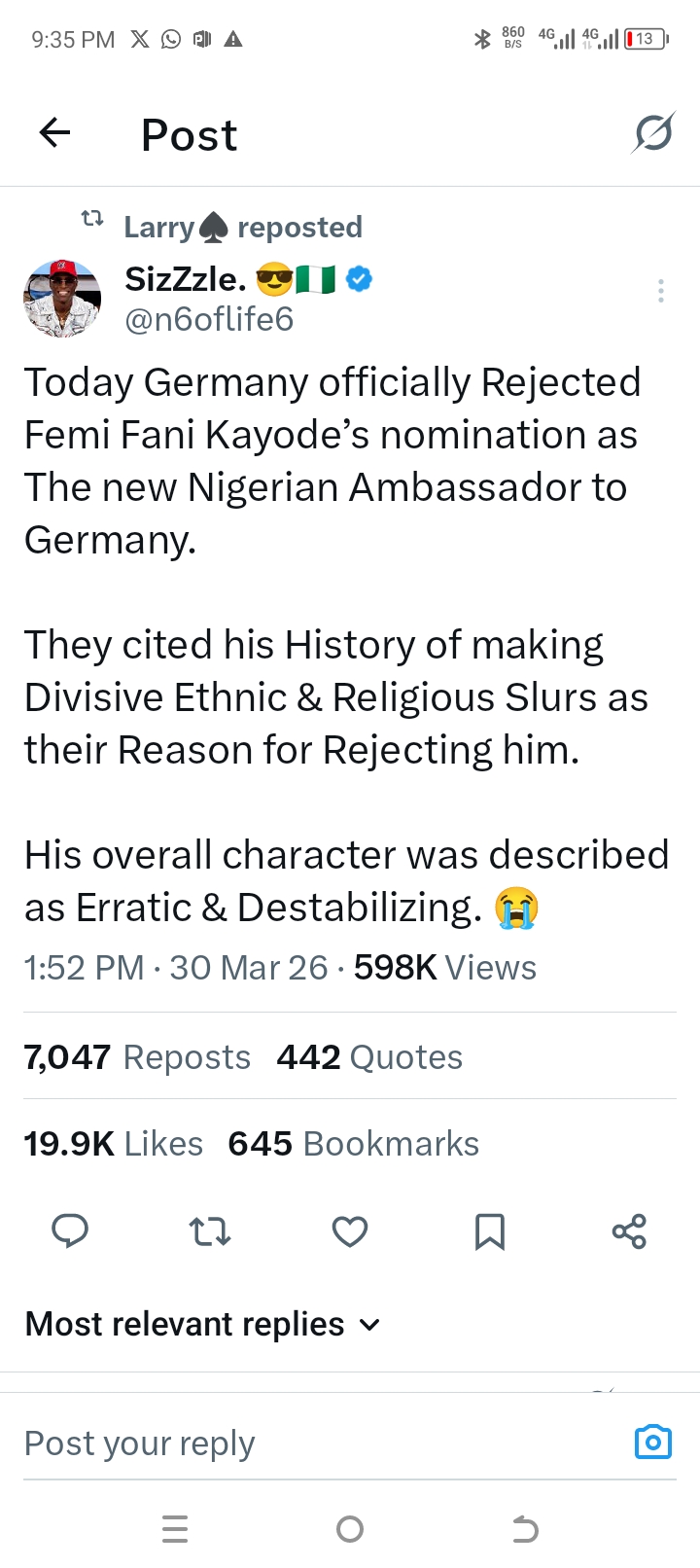
Fresh layers of controversy have emerged around the viral claim that Femi Fani-Kayode was rejected as Nigeria’s ambassador to Germany, with new assertions linking the development to alleged petitions by members of the Obidient movement.
According to narratives gaining traction online, groups sympathetic to Peter Obi are said to have mobilized opposition to Fani-Kayode’s purported nomination by submitting petitions to German authorities. These alleged petitions reportedly cited concerns over his past public statements and political conduct, arguing that such a profile could be inconsistent with the expectations of diplomatic representation in a country like Germany. While the claims have generated intense reactions across political divides, no verifiable evidence has been publicly presented to confirm that such petitions were formally received or acted upon.
The situation highlights the growing influence of transnational political engagement, particularly among diaspora communities and digitally connected political movements. In recent years, citizen-led advocacy has increasingly extended beyond national borders, with organized groups attempting to shape international opinion and, in some cases, diplomatic considerations. However, experts in international relations emphasize that ambassadorial approvals—known as agrément—are typically guided by strategic state interests, bilateral relations, and confidential assessments, rather than public campaigns or social media pressure.
Equally important is the absence of any official confirmation that Femi Fani-Kayode was formally nominated for the ambassadorial role in the first place. Without a confirmed nomination from the Nigerian government, claims of rejection—whether linked to petitions or otherwise—remain speculative. Diplomatic protocol dictates that such processes are handled discreetly, with outcomes rarely disclosed in the public domain unless formally announced by one or both governments.
Political observers note that the rapid spread of this narrative underscores the power of digital ecosystems in shaping political perception, often blurring the line between verified developments and conjecture. The involvement of identifiable political blocs, such as the Obidient movement, further intensifies the narrative, framing it within Nigeria’s broader political contest and amplifying its emotional and partisan appeal.
At the same time, the episode raises deeper questions about reputation, global scrutiny, and the evolving standards for diplomatic representation in an interconnected world. Public figures seeking international roles are increasingly subject to scrutiny that transcends national boundaries, with past statements and political positioning becoming part of a global evaluative lens—whether formally acknowledged or not.
For now, the claims remain unverified and developing. Stakeholders and the general public are advised to exercise caution, pending authoritative statements from the Nigerian government or German officials that can definitively clarify the situation.
As the story continues to unfold, it stands as a reminder of how modern politics operates at the intersection of local actions, global perception, and digital amplification—where narratives can travel faster than facts, and speculation can quickly assume the weight of reality.
🚨 BREAKING NEWS: Claims of Obidient Petitions in Alleged Germany Snub of Fani-Kayode Stir National Debate

- Advertisement -

