

Politics often rewards strategy—but it punishes overreach. What unfolded this week in Nigeria’s shifting political landscape reads less like a coordinated master plan and more like a cautionary tale unfolding in real time. At the center of this developing narrative is Wednesday’s alleged interference—an episode that may ultimately shape everything that follows.
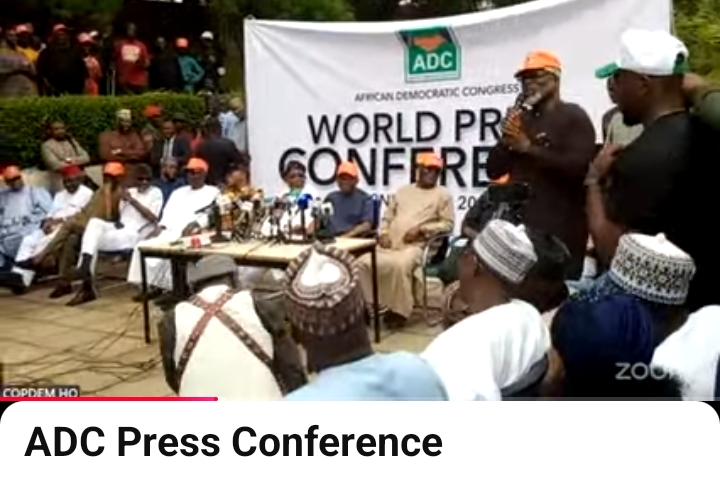
Monday and Tuesday laid the groundwork. The momentum of the African Democratic Congress (ADC) surged significantly, driven by reported political realignments. The entry of Rabiu Kwankwaso was said to bring substantial electoral weight in Kano, with Nasiru Gawuna also contributing notable support. These were not incremental developments—they pointed to a deeper shift in voter alignment. By Tuesday evening, signals from Bala Mohammed suggested that interest in the emerging coalition was widening. The political atmosphere was already charged.
Then came Wednesday.
Allegations emerged that Bola Tinubu and the All Progressives Congress (APC), acting through the Independent National Electoral Commission (INEC), sought to trigger internal disarray within the ADC. The perceived aim was to disrupt consolidation efforts and discourage further defections at a critical moment.
On paper, this aligns with conventional political containment strategy.
In reality, it may have produced the opposite effect.
Rather than fragmenting the opposition, the events that followed appeared to energize it. By Wednesday evening into Thursday, reactions intensified across public discourse. Digital activism surged, party registrations reportedly spiked, and public engagement grew more visible. What may have been intended as suppression instead reinforced a narrative already gaining traction—that the rising opposition was being challenged by entrenched power structures.
This is where strategy transforms into symbolism.
The alleged interference did not weaken the ADC; it elevated its profile. It shifted perception—casting the party not just as an emerging force, but as one confronting institutional pressure. Historically, such moments tend to galvanize public sympathy and deepen political alignment. By Thursday, demonstrations around INEC offices and the convergence of opposition voices suggested a new phase of cohesion.
And this is why Wednesday stands out.
Not merely for the action itself—but for the chain reaction it triggered.
Political precedents offer context. Moments where authority is perceived to overextend often generate unintended consequences. A parallel can be drawn with Donald Trump during the U.S. presidential campaign cycle, where a high-profile assassination attempt ultimately strengthened his support base rather than diminishing it. The broader lesson remains consistent: perceived victimhood can become a powerful political catalyst.
Back in Nigeria, developments by Thursday indicated a shift from fragmentation toward alignment. Political figures who once operated independently appeared to be converging, shaped by a shared narrative of opposition. Public sentiment, reflected in protests and commentary, showed signs of moving from passive concern to active engagement.
As Friday unfolds, the central question remains:
What happens next?
If the current trajectory persists, the coming days may bring deeper consolidation—potentially through formal defections, strategic coalitions, or the emergence of a unified opposition front capable of mounting a formidable electoral challenge.
At its core, the situation reflects a simple but enduring political truth:
Wednesday was intended to slow the ADC.
It may instead have accelerated it.
In politics, the most consequential misstep is not merely failure—it is backlash.
—Written by Ogbuefi Ndigbo


